HiSiaddi is an innovative foreign trade service provider driven by technological transformation and cross-border trade under the "1+2+3+4=1" service framework, supplying alpha-arbutin sourced from multiple reputable original manufacturers.
As a foreign trade enterprise with independent R&D capabilities, HiSiaddi frequently provides alpha-arbutin formula optimization solutions and application improvement recommendations through technological cooperation with manufacturers and precise market insight. Below is our technical consultation case for alpha-arbutin formulation optimization.
For more formula optimization consultation services, please contact HiSiaddi customer service.
Purchaser: Blanc Dermo, a premium medical aesthetic group headquartered in Barcelona, Spain. The brand operates private dermatology clinics across Spain, specializing in clinical brightening essences, post-procedure melanin-inhibiting ampoules, and high-activity spot-fading serums. All products comply with EU Regulation EC1223 and SCCS raw material safety standards, with alpha-arbutin formulated at 1.8% — far higher than the standard 0.2%~0.5% loading in generic cosmetic products. Previously, the group sourced pharmaceutical-grade alpha-arbutin exclusively from Japan with an annual procurement volume of 46 tons.
In 2025, the client switched to domestic high-purity alpha-arbutin (HPLC ≥99.5%) from a major domestic raw material manufacturer, yet mass production revealed four critical technical failures: automated feeding malfunctions, formulation stratification and hydrolysis after compounding, severe activity loss post sterilization, and hydroquinone precipitation in finished goods at the end of shelf life. The client’s in-house formulation engineers spent two and a half months iterating adjustments with no resolution, delaying new product launches and incurring over 300kg of sample waste. Raw material manufacturers only guaranteed raw material factory indicators with no capability to support downstream formula adaptation or production process optimization. The group fully entrusted HiSiaddi to deliver full-chain technical implementation covering raw material modification, formula optimization, and production process rectification.
Target raw material grade: Pharmaceutical refined alpha-arbutin with strict controls on β-arbutin isomer <0.1% and free hydroquinone <0.2ppm, exclusively for high-concentration EU medical aesthetic formulas — distinct from generic 99% national standard cosmetic bulk materials.
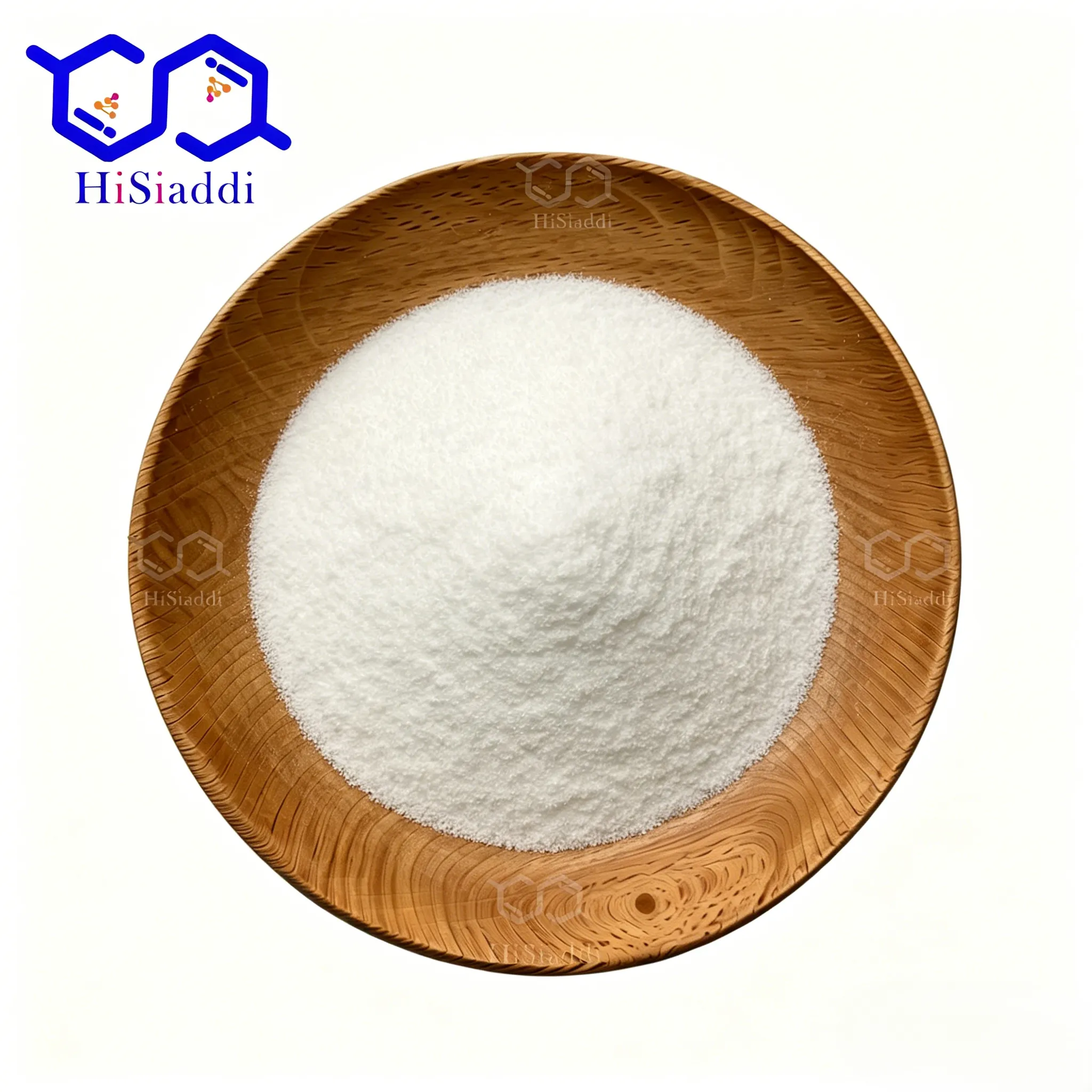
Generic standard alpha-arbutin from manufacturers is supplied as 140-mesh ultra-fine crystalline powder with a large specific surface area and strong moisture absorption. The client’s Spanish production plant maintains a constant ambient humidity of 55% RH; raw materials clump within 30 minutes of unpacking, frequently blocking negative-pressure automated feeding pipelines. Insufficient dissolution during stirring leaves insoluble white particles in finished serums, causing pilling upon application and rejection by clinical end customers. Manufacturers operate fixed rapid cooling crystallization lines to produce only fine powder, refusing to adjust crystal particle morphology, and the client cannot modify factory temperature/humidity controls.
Core client formula: 1.8% alpha-arbutin + 12% L-Ascorbic Acid + 3% Niacinamide. L-Ascorbic Acid requires a low pH of 3.2~3.8 to retain activity, while alpha-arbutin remains stable only at pH 5.0~6.8. Mixed formulation creates pH imbalance leading to oil-water stratification after 15 days at ambient temperature. After 30 days of 45°C accelerated stability testing, glycosidic bond hydrolysis elevates finished product free hydroquinone to 1.1ppm, breaching EU cosmetic safety thresholds and preventing Spanish drug administration filing. Raw material suppliers only provide standalone CoA documents with no compound compatibility data or formula adjustment guidance.
The client’s finished product production uses an 82°C water bath pasteurization process lasting 15 minutes. Domestic raw materials suffer a 21% loss of alpha-arbutin activity post sterilization, compared to under 6% loss for Japanese imported equivalents. Finished products fail melanin inhibition efficacy testing and cannot be distributed to chain medical aesthetic clinics. Manufacturers only control raw material purity without researching heat resistance process improvements.
1% aqueous solution pH varies broadly between 5.3~6.7 across different manufacturer batches. The client’s fixed formula requires a final pH locked at 5.7±0.2. Raw material pH fluctuations cause continuous acid value decline over two months of storage, accelerating alpha-arbutin hydrolysis and failing to meet the EU mandatory 24-month shelf life standard for skincare products.
1. HiSiaddi coordinated with the manufacturer’s refining workshop to redesign cooling crystallization curves, replacing rapid quenching with gradient slow temperature-controlled crystallization to adjust 140-mesh fine powder to 85-mesh quasi-spherical crystals with a repose angle of 33°±2°, drastically reducing specific surface area and moisture absorption rates.
2. Trace amounts of compliant pharmaceutical anti-caking excipients were added to finished materials, packaged in double-layer vacuum aluminum foil bags with desiccants. Products arrive in Spain without caking for up to four hours after unpacking, enabling unobstructed automated feeding.
3. A terminal pH buffering stage was added during raw material production to lock 1% aqueous solution pH at 5.8~6.0 with single-batch fluctuation limited to ≤±0.12, completely eliminating finished product acid drift triggered by raw material pH variability.
Modified samples were sent to Spanish laboratories for full re-testing, achieving complete dissolution with no white residual particles.
Partnering with domestic skincare R&D laboratories and aligned with EU formulation regulations, HiSiaddi optimized the original formula from three dimensions:
1. Segregated feeding reform: Eliminate simultaneous addition of all components in a single mixing tank. Alpha-arbutin is fully dissolved separately in neutral aqueous phase at ≤40°C; L-Ascorbic Acid is pre-formulated as anhydrous alcoholic phase, then slowly blended at low temperature (<40°C). Niacinamide is added mid-process to avoid direct contact between strongly acidic L-Ascorbic Acid and alpha-arbutin, which breaks glycosidic bonds and triggers hydrolysis.
2. Add composite buffer system: 0.2% sodium citrate-citric acid buffer is incorporated into the formula to lock overall finished product pH at 5.6~5.9, preventing long-term storage pH drift.
3. Minor raw material ratio adjustment: L-Ascorbic Acid loading reduced by 0.8% with small additions of antioxidant auxiliaries, eliminating stratification and hydroquinone precipitation without altering whitening product claims or sensory texture.
Optimized samples remained transparent with no stratification after 90 days ambient storage; free hydroquinone stabilized at 0.18ppm after three months of 45°C accelerated testing, complying with EU limits.
1. Raw material-side optimization: Deep removal of trace residual organic acids during manufacturer refining to reduce hydrolysis triggers under high-temperature conditions and enhance raw material heat resistance.
2. Mass production process optimization: HiSiaddi recommended splitting sterilization workflows: aqueous base materials undergo pre-sterilization at 75°C for 8 minutes, cooled to 38°C before sterile addition of alpha-arbutin and L-Ascorbic Acid active ingredients to avoid direct thermal degradation of actives. Post-rectification activity loss after sterilization fell to under 6.5%, matching the efficacy performance of Japanese imported raw materials.
HiSiaddi coordinated with manufacturers to issue bilingual Chinese-English CoAs listing separate test data for isomers, hydroquinone, and solvent residues, paired with formula adjustment reports and raw stability test original data, supporting the client’s SGS efficacy testing and CPNP registration in Spain.
1. Client Benefits: The 46-ton annual order of modified customized alpha-arbutin was shipped to Barcelona in five batches with smooth customs clearance. Optimized high-concentration spot-fading serums and medical ampoules completed Spanish drug administration filing and launched across over 360 private medical aesthetic institutions nationwide. Comprehensive raw material procurement costs decreased by 32% versus Japanese imports, and a renewed 51-ton annual long-term order was signed the following year alongside joint R&D for deoxyarbutin new customized grades.
2. Manufacturer Benefits: This technical renovation project for a major Spanish client enabled standardized mass production of spherical modified alpha-arbutin, establishing refined internal pH control and heat resistance systems. Subsequent customized orders were secured from three European clinical skincare brands in Portugal and Greece, delivering a 28% export premium for high-end modified grades.
3. HiSiaddi Foreign Trade Benefits: A full-chain technical service model for alpha-arbutin was finalized covering "raw crystal modification + formula compatibility optimization + mass production sterilization process rectification". Service scope was expanded to technical support for other premium brightening raw materials including Tranexamic Acid, 377, and Kojic Acid.
Most domestic alpha-arbutin manufacturers only control factory physical and chemical indicators via standardized mass production, lacking capabilities for downstream skincare formula development and end-product production process support. Mid-to-high-end European medical aesthetic brands feature high active ingredient loadings, complex compound systems, and stringent EU safety regulations; minor raw material indicator deviations can lead to finished product scrappage and failed market launch. Drawing on industrial chain resources and formulation R&D expertise, HiSiaddi systematically resolved full-chain technical challenges through three core dimensions: upstream raw material modification, formula system restructuring, and sterilization production process optimization, breaking technical barriers preventing domestic high-end alpha-arbutin from entering mid-to-high-end Southern European skincare supply chains.
For more formula optimization consultation services, please contact HiSiaddi customer service.

 +86-13120989737
  info@hisiaddi.com
 English