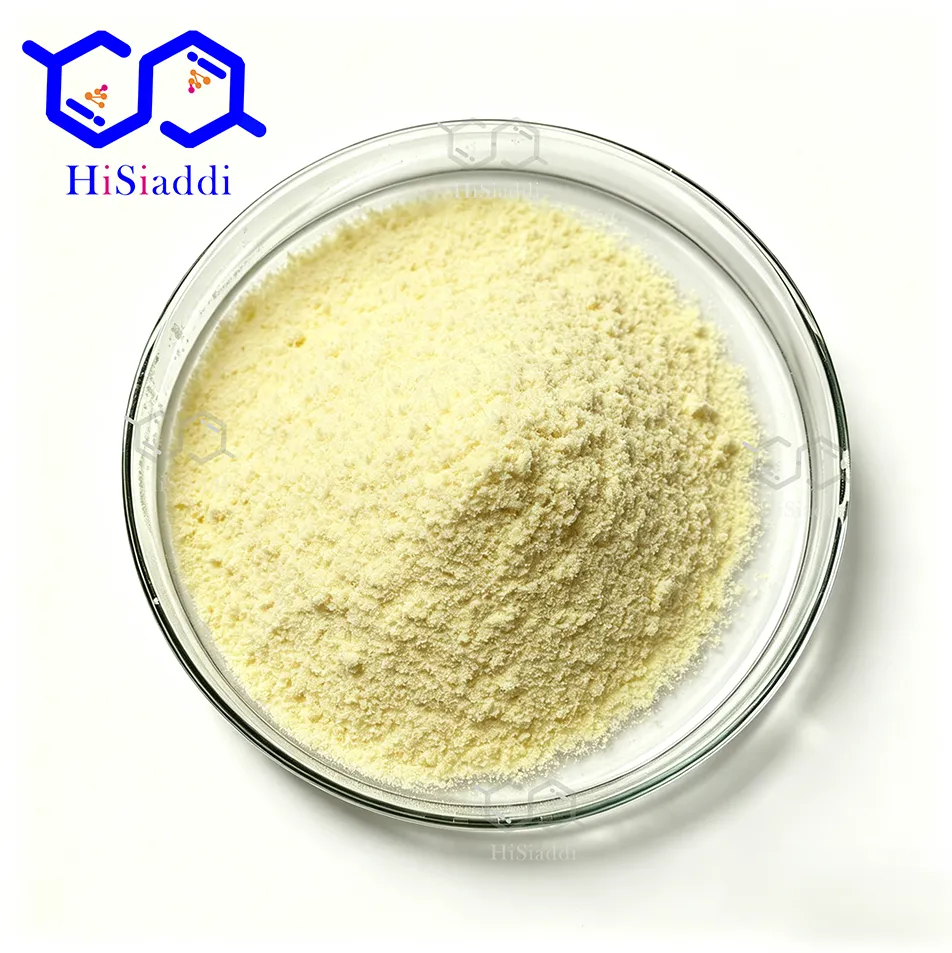
UV Absorber 1577, abbreviated as UV 1577, is a high-heat-resistance and low-volatility triazine UV absorber applied in electronic shells and optical plates. HiSiaddi can provide original factory supplies of multiple Chinese brands and the "1+2+3+4=1" service.
Rianlon launches RIASORB UV-1577 (purity ≥99.0%) and UV-1577H (high-purity grade, purity ≥99.5%) with melting point 147-151℃, volatile content ≤0.2%, excellent thermal stability (5% weight loss at 321℃), perfect compatibility with PC and no precipitation under high-temperature processing. Benchmarking BASF Tinuvin 1577 at an 18%-22% lower price, it adapts to European automotive PC component factories and North American optical plate enterprises.
Disheng supplies DS-1577 (purity ≥98.5%) and DS-1577E (electronic grade, purity ≥99.0%) with purity ≥98.5%, ash content ≤0.1% and light transmittance ≥97% at 500nm, low dust and easy dispersion, priced 5%-8% lower than Rianlon at the mid-end level.
HiSiaddi Exclusive Service: Offers consultation on key indicator & cost comparison of multiple brands, PC/polyester anti-aging formula optimization, high-temperature processing stability scheme and HALS synergistic system adaptation; provides melting point/TGA thermal stability and metal impurity ICP-MS testing.
 CONTACT HiSiaddi NOW
| CAS No: | 147315-50-2 | Brand Name: | Multi-brand |
| MF: | C27H27N302 | Model Number: | Multi-models |
| EINECS No: | 411-380-6 | Grade: | Industrial grade |
| Purity: | 99% | Place of Origin: | Shandong, China |
| MOQ: | 1ton | Storage: | Please refer to the product packaging or contact the customer service. |
When purchasing UV‑1577 as a buyer, you may encounter the following questions:
What are the key indicator advantages of mainstream grades from well‑known UV‑1577 brands and their impacts on application performance?
What competitive services can UV‑1577 suppliers provide?
What are the qualification certifications and market feedback of target UV‑1577 brands?
What is the inventory level and supply stability of UV‑1577 suppliers?
What factors should be considered when selecting UV‑1577?
…and many other relevant questions.
Main grades: RIASORB® UV‑1577 (Standard Grade), UV‑1577‑H (High Heat‑Resistant Grade), UV‑1577‑E (Eco‑friendly High‑Purity Grade)
Purity ≥99.2%, free impurities ≤30 ppm, free of heavy metals/free chlorine, compliant with food contact and medical‑grade requirements;
Melting point: 148–150°C, thermal stability at 300°C (5% weight loss), suitable for high‑temperature extrusion of PC (280–300°C) and high‑temperature curing of automotive coatings;
Volatile matter ≤0.2% (150°C/2h), extremely low migration; no blooming or white spots in PC films (≤10 μm) and optical sheets;
Light transmittance ≥88% at 460 nm and ≥98% at 500 nm, high transparency and low haze, with no negative impact on gloss and clarity of high‑end transparent products;
UV absorption peak at 355 nm, molar extinction coefficient ≥1.6×10⁴ L·mol⁻¹·cm⁻¹; long‑term UV resistance achieved with low dosage (0.2–0.4%);
Low haze value (≤1.0), low fogging for automotive interiors, meeting European and American VOC standards.
Cost‑performance Ratio: Mid‑to‑high end ($15.8–17.5/kg, FOB Shanghai), 22–28% lower than BASF Tinuvin 1577. It delivers world‑class performance with leading thermal stability and low volatility, bringing lower overall long‑term costs.
Target B‑end Buyers: High‑end PC sheet manufacturers, automotive OEM coating enterprises, photovoltaic backsheet producers, medical packaging factories, major overseas engineering plastic modification enterprises (e.g., Covestro (Germany), SABIC (Saudi Arabia), Tekfen (Turkey)).
For Buyers: Annual production capacity of 6,000 tons, batch‑to‑batch color difference ≤0.3, high‑purity customization available, 24‑hour technical support, full compliance documents (FDA/REACH/RoHS), low‑fogging formulation support;
For End‑users: PC sheets free from yellowing/cracking for 10 years, automotive topcoat weather resistance ≥8 years, ≥92% light transmittance retention for photovoltaic backsheets over 5 years, safe and non‑toxic medical packaging, and over 25% premium for high‑end products.
Main grades: ZH‑1577 (Industrial Grade), ZH‑1577‑P (High‑Purity Powder Grade), ZH‑1577‑C (Coating‑Special Grade)
Purity ≥99.0%, strictly controlled impurities, low odor, suitable for both engineering plastics and coatings;
Melting point: 147–149°C, thermal stability at 295°C, applicable to high‑temperature injection molding of PC/ABS alloys (260–280°C) and high‑temperature baking of coil coatings;
Volatile matter ≤0.3%, strong migration resistance, no precipitation or blooming in thick‑walled PC products (≥5 mm);
Excellent compatibility with coating resins and good dispersibility; no negative impact on gloss/adhesion in automotive coatings, salt spray resistance ≥1,000 h;
Large‑scale production capacity (5,000 tons/year), China’s leading manufacturer of triazine‑based UV‑1577, with stable quality and continuous supply.
Cost‑performance Ratio: Mid‑end ($14.2–15.5/kg, FOB Dalian), 28–35% lower than international brands. Its performance is close to Rianlon at a more competitive price, ideal for large‑scale mid‑to‑high‑end procurement.
Target B‑end Buyers: Medium‑sized PC modification factories, automotive component coating plants, photovoltaic auxiliary material enterprises, engineering plastic sheet manufacturers, high‑end coating producers in Southeast Asia (e.g., SCG (Thailand), Petronas (Malaysia), Vinacone (Vietnam)).
For Buyers: Strong price competitiveness, fast delivery (7–10 days), low MOQ (100 kg), coating formulation optimization support, free samples (1–5 kg), sufficient production capacity;
For End‑users: PC modified parts free from discoloration for 8 years, automotive component weather resistance ≥6 years, 30% longer service life for photovoltaic auxiliary materials, ≥85% gloss retention for coatings over 5 years, and 18–22% cost reduction.
Main grades: DS‑1577 (Standard Pellet Grade), DS‑1577‑P (Powder Grade), DS‑1577‑M (Modification‑Special Grade)
Purity ≥98.5%, ash content ≤0.05%, no black spots in high‑transparency products, suitable for PMMA/PS transparent articles;
Melting point: 146–148°C, thermal stability at 285°C, wide processing adaptability for extrusion/injection molding/blow molding/coating;
Volatile matter ≤0.4%, low migration, no bubbles or blooming in thin‑walled PMMA products;
Strong synergistic effect when compounded with HALS 944/Antioxidant 1010, improving anti‑aging efficiency by 40% and reducing overall additive cost by 20–25%;
Excellent cost control with large‑scale production (4,000 tons/year), outstanding cost‑performance ratio.
Cost‑performance Ratio: Mid‑to‑low end ($12.5–14.0/kg, FOB Xiamen), 10% lower than Zhonghao. It meets basic performance requirements, suitable for medium‑to‑large‑scale procurement with budget constraints.
Target B‑end Buyers: Small‑to‑medium‑sized engineering plastic factories, PMMA sheet manufacturers, ordinary automotive interior component plants, outdoor coating factories, mid‑to‑high‑end buyers in the Middle East and Africa (e.g., NPC (Iran), Orascom (Egypt), Sasol (South Africa)).
For Buyers: Low price, sufficient production capacity, flexible batch delivery, fast after‑sales response, support for small‑batch trial orders (50 kg), OEM labeling available;
For End‑users: PMMA sheets free from yellowing for 5 years, automotive interior weather resistance ≥5 years, ≥6‑year anti‑aging performance for outdoor coatings, 22–28% cost reduction, meeting mid‑to‑high‑end UV resistance requirements.
Main grades: JK‑1577 (High‑Purity Industrial Grade), JK‑1577‑H (Ultra‑High‑Purity Electronic Grade), JK‑1577‑L (Low‑Molecular‑Weight Grade)
Ultra‑high purity ≥99.8%, metal ions ≤5 ppm, free of heavy metal residues, dedicated to electronic and medical‑grade applications;
Extremely narrow molecular weight distribution (425–435), top‑tier batch stability, ensuring perfect consistency for precision optical products (e.g., light guide plates, optical films);
Volatile matter ≤0.15%, ultra‑low migration, no blooming in ultra‑thin optical films (≤5 μm), suitable for high‑end electronic display materials;
Premium technical services including formulation design, aging tests (xenon lamp/UV), full‑process compliance certification support, and electronic‑grade clean packaging.
Cost‑performance Ratio: High‑end ($16.5–18.5/kg, FOB Beijing), priced close to top international brands. Its irreplaceable advantages in ultra‑high purity and customization target high‑end niche markets.
Target B‑end Buyers: Electronic optical material factories, medical packaging plants, precision injection molding enterprises, high‑end brand OEM manufacturers in Europe and America, laboratories and R&D institutions.
For Buyers: Ultra‑high‑purity quality, strong customization capability, professional technical support, complete compliance documents (FDA/REACH/ISO), electronic‑grade clean packaging, full‑item test reports;
For End‑users: Long‑term stability of electronic optical components, safe and non‑toxic medical packaging, flawless appearance of precision products, quality endorsement for high‑end brands, and over 35% product premium.
Main grades: TG‑1577 (Standard Industrial Grade), TG‑1577‑S (Powder Grade), TG‑1577‑G (Pellet Grade)
Purity ≥98.0%, stable basic performance, lowest price, ideal for large‑scale low‑cost procurement;
Melting point: 145–147°C, thermal stability at 280°C, compatible with general processing techniques with no special equipment requirements;
Volatile matter ≤0.5%, extreme cost control, large‑scale production (3,000 tons/year), strong price competitiveness;
Wide universality for PC/ABS/PET/PVC/coatings, enabling one‑stop procurement for multi‑category products.
Cost‑performance Ratio: Low‑end ($11.2–12.5/kg, FOB Beijing), among the lowest‑priced tier in the industry. It meets basic performance standards with ultimate cost‑performance, perfect for large‑scale procurement in low‑cost markets.
Target B‑end Buyers: Large‑scale low‑cost engineering plastic factories, ordinary pipe/profile manufacturers, buyers in Africa and South America, traders (resellers), low‑end coating factories.
For Buyers: Ultra‑low price, sufficient production capacity, fast delivery (10–15 days), support for bulk orders (≥100 tons), flexible payment terms (T/T, L/C);
For End‑users: Lowest cost for engineering plastic parts, ≥5‑year outdoor weather resistance for pipes, strong price competitiveness, suitability for mass consumer markets, and optimal cost‑performance ratio.

| Brand | Main Grades | FOB Price | Core Advantage Indicators | Target B‑end Buyers | Core Downstream Benefits |
| Rianlon | RIASORB® UV‑1577 / UV‑1577‑H / UV‑1577‑E | $15.8–17.5/kg | Purity ≥99.2%, thermal stability 300°C, volatile matter ≤0.2%, light transmittance ≥88%, haze value ≤1.0 | High‑end PC sheet manufacturers, automotive OEM coatings, photovoltaic backsheet plants, medical packaging factories, major European & American modification enterprises | PC sheets free from yellowing for 10 years, 8‑year weather‑resistant automotive coatings, high light transmittance for photovoltaic backsheets, medical‑grade safety, 25%+ product premium |
| Zhonghao Dalian Institute | ZH‑1577 / ZH‑1577‑P / ZH‑1577‑C | $14.2–15.5/kg | Purity ≥99.0%, thermal stability 295°C, volatile matter ≤0.3%, excellent coating compatibility, 5,000‑ton capacity | Medium‑sized PC modification factories, automotive coating plants, photovoltaic auxiliary material factories, high‑end Southeast Asian coating manufacturers | 8‑year fade‑resistant PC modified parts, 6‑year weather‑resistant automotive components, 30% longer service life for photovoltaic auxiliary materials, 18–22% cost reduction |
| Diseng Technology | DS‑1577 / DS‑1577‑P / DS‑1577‑M | $12.5–14.0/kg | Purity ≥98.5%, thermal stability 285°C, ash content ≤0.05%, strong synergistic effect, high cost‑performance ratio | Small‑to‑medium‑sized engineering plastic factories, PMMA sheet manufacturers, ordinary automotive interior plants, Middle Eastern & African buyers | 5‑year yellowing‑resistant PMMA sheets, 5‑year weather‑resistant automotive interiors, 6‑year anti‑aging outdoor coatings, 22–28% cost reduction |
| J&K Scientific | JK‑1577 / JK‑1577‑H / JK‑1577‑L | $16.5–18.5/kg | Purity ≥99.8%, metal ions ≤5 ppm, narrow molecular weight distribution, volatile matter ≤0.15%, electronic‑grade dedicated | Electronic optical material factories, medical packaging plants, precision injection molding enterprises, European & American high‑end OEMs, R&D institutions | Stable electronic components, safe medical packaging, flawless precision products, complete compliance certifications, 35%+ product premium |
| Tianguang Additives | TG‑1577 / TG‑1577‑S / TG‑1577‑G | $11.2–12.5/kg | Purity ≥98.0%, thermal stability 280°C, 3,000‑ton capacity, lowest price, wide universality | Large‑scale low‑cost engineering plastic factories, low‑end pipe manufacturers, African & South American buyers, traders, low‑end coating factories | Lowest production cost, 5+‑year weather‑resistant pipes, strong price competitiveness, fast bulk delivery, optimal cost‑performance ratio |
HiSiaddi as a service provider integrating technology transformation and foreign trade, have formed a "1+2+3+4=1" product service system by 1foreign trade salesperson with over 3 years of experience., 2R&D teams, 3 high-quality suppliers, and 4 warehouses to serve 1 product demand.
Relying on the dual-drive model of technology commercialization and foreign trade services, HiSiaddi has built a "1+2+3+4=1" product service system: 1 foreign trade salesperson with more than 3 years of experience, 2 R&D teams, 3 high-quality suppliers, and 4 warehouses to satisfy each single product demand.
With this service system, HiSiaddi outperforms most foreign trade companies in R&D optimization and technical craftsmanship of UV 1577 products, surpasses single factories in grasping market demands and competitive advantages of various UV 1577 brands, and understands the UV 1577 foreign trade market better than scientific research institutions.
HiSiaddi only hires foreign trade salespersons with over 3 years of working experience, who must receive more than 6 months of training from both the scientific research team and foreign trade team before serving customers.
(1)UV 1577 Basic Support Services
Relying on the foreign trade team and corporate service system, the company provides customers with one-stop full-process document handling services, including but not limited to issuance & processing of all UV 1577 compliance certificates, provision of third-party reports and follow-up handling of quality complaints.
(2)UV 1577 Exclusive Premium Services
Backed by the scientific research team, we provide customers with product customization and technical consulting services, including but not limited to core indicator adaptation & cost comparison of all UV 1577 brands, and regular market trend sharing of UV 1577 products.
We cooperate deeply with source factories via technology commercialization, and collaborate closely with the foreign trade team internally to deliver technical training for sales staff, enabling professional product customization and providing research-grade consulting for brand matching and application optimization of UV 1577 products.
(1)UV 1577 Research-Grade Customization Services
Customize optimal UV-1577 grades and addition rates (0.25–0.35% for PC sheets, 0.3–0.5% for automotive coatings, 0.2–0.3% for photovoltaic backsheets) based on finished products (PC, automotive paint, PV backsheet), processing temperatures (260–300℃) and weather resistance standards to avoid excessive cost or insufficient UV resistance.
(2)UV 1577 Research-Grade Consulting Services
Provide process optimization solutions against precipitation and yellowing under high-temperature processing (280–300℃); offer compound formulation consulting of UV-1577 with HALS 944/622, Antioxidant 1010/168 and UV-360, boosting anti-aging capacity by 40% and reducing total additive cost by 25–30%.
Our foreign trade and R&D teams work in tandem. Through preliminary market research, on-site factory inspections, product testing, in-depth technical cooperation and procurement partnerships, we select around 3 reliable, stable, reputable and high-potential brand manufacturers.
(1) Initiative to Secure Lower Raw Material Prices
Long-term cooperation via technology transfer and exclusive agency allows us to source factory direct supplies at more competitive prices.
(2) UV 1577 Long-Term Supply Chain Assurance Services
Long-term technical and agency cooperation strengthens full production monitoring, full batch traceability, consistent batch quality control, and compensation guarantees for unqualified products failing third-party inspections.
We have 4 warehouses, which are jointly operated and managed with suppliers to store hot-selling products .
(1)UV 1577 Fast Local Delivery & On-Site Problem Resolution
Our four warehouses are located at Qingdao Port (North China), Ningbo Port (East China), Shenzhen Port (South China) and Zhengzhou (inland logistics hub), enabling timely delivery of UV 1577. On-site staff are available to resolve transport damage, packaging defects and export compliance issues locally when UV 1577 encounters abnormal conditions.
(2) UV 1577 Price Stabilization & Custom Packaging Support
We stock up in advance during peak price seasons to mitigate drastic price fluctuations. Self-operated warehouses support customized packaging and label solutions to meet personalized client demands.
As a new-type foreign trade service provider driven by both technology transformation and foreign trade services, HiSiaddi has built a "1+2+3+4=1" service system and can supply original factory sources of UV 1577 from multiple well-known brands. As a research & development-oriented foreign trade service provider, HiSiaddi will systematically sort out common difficulties faced by B-end buyers sourcing UV 1577 in China and propose targeted solutions from a professional perspective.
If you require more professional and in-depth analysis regarding UV 1577 procurement, please contact HiSiaddi customer service.
1. Impairment of UV resistance by impurities, melting point fluctuations disrupting high-temperature injection molding, high volatile content causing mold fouling, trace residues triggering yellowing of light-colored products, and uneven particle size inducing stress cracks
· Triazine isomers and unreacted raw material impurities generated during synthesis feature low UV absorption efficiency. Mixed into raw materials, they directly reduce overall anti-UV performance, leading to gloss loss, discoloration and decreased mechanical strength of automotive exterior parts and outdoor engineering plastic components after short-term sunlight exposure, failing to meet the 5+ year weather resistance standard for complete vehicles.
· Wide melting point range fluctuations across batches. Processing temperatures for this product generally range from 280–320°C; repeated adjustments to barrel and mold temperatures during injection molding and extrusion easily trigger partial thermal decomposition of materials, plastic part color difference and flash defects, forcing production line shutdowns for parameter calibration and reducing continuous production efficiency.
· Excessive raw material volatile content continuously vaporizes under ultra-high-temperature processing, forming stubborn carbon deposits and scale on screw and mold cavity inner walls. This damages plastic part surface smoothness and requires periodic deep disassembly and cleaning of equipment, increasing operation and maintenance costs and downtime.
· Low-molecular thermally unstable residual components decompose under combined light and high temperature, causing overall yellowing and local color difference of white and light gray high-gloss plastic parts, directly classifying finished products as unqualified and raising scrap rates.
· High proportion of coarse powder particles and wide particle size distribution lead to uneven dispersion in glass fiber reinforced plastics, forming local stress concentration points. Plastic parts easily develop microcracks under stress or thermal cycling, shortening service life and compromising safety performance.
1. Adopt combined multi-stage recrystallization and precision rectification processes to deeply remove low-efficiency isomers and organic impurities, stabilizing main content at ≥99.2% for long-lasting UV absorption performance, enabling outdoor weather resistance of finished products exceeding 8 years.
2. Controlled constant-temperature directional crystallization technology limits batch melting point fluctuation within ±1°C, allowing customers to fix full-range injection molding and extrusion temperature parameters without frequent adjustments for stable continuous molding processes.
3. Add high-temperature negative-pressure devolatilization procedures to control 105°C volatile content ≤0.2%, generating minimal volatiles under 320°C high-temperature processing, significantly reducing mold and screw fouling and extending equipment cleaning intervals.
4. Deep refining eliminates yellowing-prone small-molecule intermediates paired with thermal stability modification, delivering stable appearance quality without obvious yellowing of light-colored and high-gloss plastic parts during long-term service.
5. Jet milling plus multi-stage grading strictly controls powder particle size and distribution, enabling uniform dispersion of fine particles in resin and glass fiber systems to eliminate stress hazards and prevent plastic part cracking.
Insufficient light transmittance impairing optical performance of panels, excessive ash content reducing mechanical and weather resistance, moisture inducing bubble defects in panels, component fluctuations causing batch weather resistance differences, and insufficient extraction resistance accelerating performance attenuation
1. Colored impurities and conjugated organic residues reduce raw material light transmittance, raising haze and uneven light transmission of high-transparency PC sun panels and photovoltaic backsheets. This compromises lighting effects and interferes with photoelectric conversion efficiency of photovoltaic modules, failing to meet industry optical indicators.
2. Excessive inorganic ash content damages polymer molecular chain structures, lowering tensile strength and impact resistance of panels while accelerating photoaging. Panels tend to embrittle and crack during outdoor service.
3. Moisture absorption-induced excess water content in raw materials vaporizes during panel extrusion molding, forming microbubbles and voids inside panels. This impairs appearance and drastically reduces overall compactness and wind resistance of panels.
4. Deviations in active effective component ratios across batches lead to inconsistent UV resistance of mass-produced panels, triggering after-sales disputes when partial panels suffer premature aging after end-project deployment.
5. Conventional grades feature weak resistance to solvent and rainwater extraction. Long-term outdoor rain and moisture immersion gradually leach out UV 1577, rapidly attenuating anti-UV capacity and shortening the designed service life of photovoltaic and outdoor panels.
1. Activated carbon deep decolorization plus multi-stage precision filtration delivers qualified raw material light transmittance and ultra-low haze, safeguarding optical performance and photoelectric conversion efficiency of transparent panels and photovoltaic backsheets.
2. Multi-stage filtration removes inorganic impurities with ash content strictly controlled ≤0.03%, fully preserving material mechanical properties and delaying aging to boost outdoor service reliability of panels.
3. Vacuum constant-temperature drying achieves deep dewatering with moisture ≤0.03%, paired with fully sealed moisture-proof packaging to completely eliminate bubble and void defects in panels.
4. Automated closed parameter-locked production unifies effective component ratios across batches for highly consistent panel weather resistance and stable mass production quality.
5. Special purification optimizes molecular structures to strengthen resistance to rainwater and solvent extraction, preventing loss of active ingredients and meeting the 20+ year long-term service requirements of photovoltaic and outdoor panels.
Impurities triggering paint film chalking and peeling, poor thermal stability causing discoloration at high temperatures, powder agglomeration blocking coating equipment, residual organics generating irritating odors, and formulation compatibility fluctuations inducing coating stratification
1. Inert organic impurities catalyze photo-oxidative aging of paint films, leading to surface chalking, peeling and loss of anti-corrosion and weather-resistant functions within short-term outdoor exposure, failing heavy-duty anti-corrosion engineering standards.
2. Insufficient raw material thermal stability triggers UV 1577 decomposition during high-temperature coating baking (180–250°C) or high-temperature service of workpieces, causing paint film discoloration and gloss loss and damaging protective and decorative effects.
3. Powder absorbs moisture and agglomerates during storage and transportation. After incorporation into coating systems, agglomerates cannot be fully dispersed, easily blocking spray filters and high-pressure gun nozzles and forcing production line shutdowns for cleaning, lowering coating efficiency.
4. Low-boiling organic synthesis residues continuously volatilize during coating preparation and construction, producing irritating odors exceeding European and American workplace occupational health and VOC control standards.
5. Fluctuations in physical and chemical indicators across batches impair compatibility with resins, pigments, fillers and other additives, leading to stratification, precipitation and abnormal viscosity of coatings during storage and disrupting construction stability.
1. Deep refining removes all types of inert impurities to inhibit paint film aging and chalking, enhancing long-term anti-corrosion and weather-resistant performance of coatings for outdoor heavy-duty anti-corrosion applications.
2. Thermal stability modification raises thermal decomposition temperature to prevent decomposition and discoloration under high-temperature baking and working conditions, delivering long-lasting stable paint film gloss and protective performance.
3. Pre-treatment of powder for anti-caking paired with moisture-proof sealed packaging ensures smooth feeding and dispersion without clogging coating equipment for uninterrupted continuous production.
4. Negative-pressure flash evaporation removes volatile odor components, aligning VOC and odor indicators with European and American environmental and EHS requirements and improving workshop operating environments.
5. Standardized mass production unifies all physical and chemical indicators for stable compatibility with mainstream coating resins and additives, eliminating stratification and precipitation of coatings during long-term storage.
High cost of high-purity grades squeezing profit margins, substandard weather resistance of industrial crude products, frequent batch indicator fluctuations for large-tonnage shipments requiring repeated process adjustments, moisture-induced agglomeration under high-temperature and high-humidity storage & transportation, and missing compliance documents preventing local filing
1. High procurement costs of refined high-end UV 1577 compress profit margins for mass production of low-end plastic products and civil coatings; low-cost industrial crude products feature low purity and abundant impurities with weak UV absorption capacity. End products rapidly age and discolor outdoors, failing local basic usage standards and creating a dilemma between cost and quality.
2. Insufficient effective light-stabilizing components in crude products result in short weather resistance lifespans of plastic parts and coatings, with frequent cracking and fading leading to high end-product rework rates and ultimately higher comprehensive usage costs.
3. Significant batch differences in melting point, purity, particle size and other indicators during large-tonnage supply force production lines to repeatedly adjust processing temperatures, additive ratios and stirring parameters, with frequent equipment shutdowns for calibration drastically reducing capacity utilization.
4. High-temperature and high-humidity ocean transportation and storage in the region render ordinary packaging inadequate for moisture sealing. Powder easily absorbs moisture and hardens, disrupting normal feeding and dispersion and directly causing material loss and production delays.
5. Lack of English CoA, MSDS, REACH compliance statements and other basic documents prevents industrial product filing and routine local sampling inspections, restricting sales to informal low-end channels with risks of payment recovery and regulatory non-compliance.
1. Launch cost-effective general industrial grade UV 1577 with simplified deep recrystallization and other high-end refining procedures. Core indicators meet basic usage requirements for ordinary outdoor rubber and plastic products and civil coatings, with prices over 25% lower than high-end grades to boost profit margins.
2. Basic removal of major harmful impurities retains sufficient effective light-stabilizing components to guarantee fundamental anti-aging and UV resistance of end products and extend service life.
3. Standardized parameter-locked mass production narrows batch indicator deviations, allowing customers to fix production processes long-term and reduce equipment calibration frequency to fully release production capacity.
4. Adopt thickened outer packaging + double-layer PE moisture-proof inner liners + built-in desiccants for enhanced moisture protection, preventing moisture absorption and agglomeration during ocean transportation and storage for normal feeding and usage.
5. Supply streamlined English document packages including test reports, MSDS and REACH compliance statements to meet local regulatory filing and routine sampling inspection requirements, supporting expansion into formal supply chains.
Fake low-purity crude products falsely labeled with inflated purity and thermal stability indicators, powder leakage and agglomeration during transit, performance attenuation after long-term storage and transportation, incomplete hazardous chemical compliance documents, and absence of third-party reports leading to loss of high-end customers
1. Counterfeit low-purity crude products mixed with fillers are circulated in the market with falsely marked main content, thermal stability and weather resistance parameters. Usage by downstream automotive, photovoltaic and high-end coating customers triggers mass quality accidents, high compensation claims and severe damage to channel reputation.
2. Poor packaging sealing and insufficient container compression resistance cause powder leakage during ocean stacking and handling, resulting in material loss, cross-contamination of adjacent goods and logistics disputes. Moisture absorption also induces agglomeration, disrupting normal usage by end customers.
3. Simple packaging lacks light and oxygen isolation. Raw materials gradually oxidize and degrade during long-distance cross-border transportation and storage, reducing effective component content and weather resistance performance, leading to direct rejection by high-end buyers.
4. Classified as a combustible solid chemical, UV 1577 cannot enter formal supply chains of top European and American factories and brands without English SDS, REACH-SVHC screening reports and marine dangerous goods identification documents, limiting market reach to low-end circulation channels only.
5. Inability to provide authoritative third-party full-indicator test reports and complete batch traceability records prevents passing supplier admission audits of European and American enterprises, resulting in missed long-term high-quality bulk orders.
1. Direct supply of genuine original factory products with truthful labeling of all physical, chemical and performance parameters. Every batch is accompanied by third-party full-indicator test reports supporting re-inspection by global institutions, eliminating adulteration and false labeling and avoiding after-sales compensation risks from the source.
2. Uniform double-layer sealed inner liners + thickened iron drum packaging with full sealing, compression and leakage testing of each unit before factory shipment for zero powder leakage during transit. Paired with anti-caking treatment, powder condition remains intact throughout storage and transportation.
3. Special light and oxygen isolating packaging paired with long-acting antioxidant additives inhibits raw material oxidative degradation, maintaining stable purity and weather resistance performance after long-term storage and cross-border transportation without obvious attenuation of product grade.
4. One-stop supply of complete English compliance documents including SDS, REACH-SVHC reports, marine hazardous goods identification documents and heavy metal test reports to support expansion into high-end European and American circulation channels.
5. Establish full-process batch traceability archives with complete records of production, quality inspection, storage and transportation to fully cooperate with customer factory audits and supplier reviews and stabilize long-term cooperative orders.
For more professional and in-depth analysis regarding UV 1577 procurement, please contact HiSiaddi customer service.
Complex byproducts generated during the stepwise etherification condensation of cyanuric chloride, creating major difficulties in deep removal of trace free phenols. UV-1577 is synthesized via three sequential substitution steps where the three chlorine atoms on cyanuric chloride are gradually replaced by phenyl and hexyloxy groups. Unreacted hexyloxyphenol monomer remains at the reaction endpoint. Phenolic impurities feature strong polarity and readily volatilize and precipitate under high temperatures. Conventional single-pass recrystallization only removes 52% of free phenols. To control levels within 28 ppm, multi-stage high-temperature precipitation with high-boiling solvents paired with a fixed bed of phenol-specific chelating resin for impurity capture is required. Deep refining reduces product yield, creating extreme difficulty in balancing purity, yield, and cost.
Extremely stringent precise control for ultra-high temperature and low volatility: trace short-chain etherification byproducts sublime at 320°C and adhere to ultra-thin extrusion dies to form hard scale. Production line shutdowns for die cleaning risk scrapping entire substrate rolls. A dedicated extreme vacuum high-temperature devolatilization section operating at 310°C is required, with an extremely narrow adjustable window for process temperature and vacuum degree.
Cumbersome consistency control for batch light transmittance and UV absorption: trace phenolic impurities alter the product’s visible light transmittance and UV absorption intensity. The customer mandates film haze fluctuation ≤0.2% across production batches. Full-process raw material graded feeding, segmented temperature-controlled condensation, precise fraction cutting during recrystallization, and real-time light transmittance monitoring via on-line spectrophotometers are mandatory.
Bidirectional optimization balancing low hot water extractability and high transparency compatibility: incompletely substituted short-chain byproducts readily migrate and precipitate from transparent substrates during hot water immersion. While high-temperature fractional precipitation must eliminate short-chain fractions, it cannot compromise the melt dispersion transparency of the product in PC and PI materials. Minor process adjustments directly impact film haze indicators.
Ultra-fine particle size matching for ultra-thin casting extrusion conditions: excessively large auxiliary agent particles form crystal spots and surface blemishes on cast optical films, while overly fine particles agglomerate via static electricity and block extrusion filter screens. Low-temperature airflow ultra-fine pulverization plus multi-stage classification is required, with particle size deviation across production batches controlled within 3.5%.
Lengthy testing cycles for dual EU food and automotive compliance: EU 10/2011 food contact testing with three categories of simulant liquid immersion and automotive ELV hazardous substance screening must be completed by certified laboratories based in Switzerland; test reports issued domestically are not recognized by Swiss customs or optical brands. Multilingual document compilation, overseas filing, and compliance review entail lengthy timelines.
Challenging moisture-proof and anti-agglomeration storage for ultra-fine crystalline powder during transoceanic shipping: although UV-1577 ultra-fine powder has weak hygroscopicity, it clumps and agglomerates under high humidity. Temperature and humidity conditions fluctuate widely on China-Europe ocean shipping routes, requiring strict vacuum sealing and temperature-controlled transportation and storage standards.
Severe full-chain delivery pressure within the 43-day tight cycle: multiple closely coordinated stages including air shipment of samples, parallel small-scale trials for four material types, continuous mass production of 35 tons, full precision testing, compliance document preparation, customs clearance, and vessel loading. Production lines operate three shifts 24 hours a day with full-process quality control on duty.
Crude products lacked phenolic adsorption refining, with free phenol levels ≥190 ppm, causing volatilization-induced die buildup and precipitation that hazed films;
High content of incompletely substituted short-chain byproducts led to excessive hot water extraction precipitation, forfeiting EU food export eligibility;
Effective purity below 98% created inconsistent UV absorption and uneven film weather resistance across batches;
Absence of high-temperature devolatilization processes resulted in volatiles ≥0.48% at 320°C, sustaining sublimation and die scaling;
Lack of vacuum sealed packaging caused ultra-fine powder clumping and agglomeration under Thailand’s hot and humid climate;
No factory quality control procedures, leading to random fluctuations in batch purity, particle size, and impurities with fixed production processes absent;
Raw material receiving inspection relied solely on visual appearance, allowing unqualified raw materials to enter full-scale production and trigger mass scrapping.
All crude product inventory was suspended and replaced with HiSiaddi’s high-purity, low-phenol optical-grade UV-1577;
A dedicated sealed constant-temperature storage room for optical additives was established, equipped with dehumidification and light-shielding equipment, maintaining warehouse temperatures of 23–31°C and humidity ≤58%. Raw materials were stacked under vacuum seal with a first-in, first-out inventory protocol;
Mandatory five-item incoming inspection standards were implemented: HPLC purity, free phenol content, high-temperature volatiles, powder particle size, and PC film haze variation, with full batch rejection for non-compliant materials;
Extrusion temperature, additive loading dosage, and screw shear parameters were fine-tuned for the two PC/PET production lines;
Clumped powder was low-temperature dried and sieved prior to feeding, open feeding durations were minimized, and dust baffles were installed at feeding stations;
A full-process UV-1577 operation manual was compiled, with hands-on training provided for all production staff.
Lead time
Quantity (ton) | 0 - 10 | 10 - 30 | > 30 |
Lead time (days) | 7 | 15 | To be negotiated |
The monthly inventory volume of UV 1577 is 15 tons, with appropriate adjustments upwards or downwards in response to peak and off-peak seasons.
HiSiaddi safeguards the supply stability of UV 1577 through the following measures:
(1) Performance evaluation and screening of UV 1577 brand factories based on on-time delivery rate, batch pass rate, timeliness of risk alerts, and completeness of documentation to assess their supply stability.
(2) For each mainstream model or major grade of UV 1577, secure 1 primary high-quality brand manufacturer and 2 backup high-quality manufacturers.
(3) Each factory operates independent production lines in separate production zones to prevent production halts caused by major unforeseen incidents such as environmental production suspensions and power outages.
Through long-term cooperation with brand manufacturers via technology commercialization and authorized distribution channels, HiSiaddi can effectively strengthen supervision over the production processes of brand manufacturers, optimize full-process traceability management, improve batch stability control, and further reinforce real-time monitoring of the supply stability of UV 1577 products.
Long-term Annual Framework Supply Guarantee Agreement. HiSiaddi signs 12-month long-term agreements with leading manufacturers. The agreements specify the minimum guaranteed supply volume, maximum price hike range, and priority production scheduling rights during peak seasons. It is stipulated that manufacturers shall issue a 30-day prior written notice if production is suspended due to environmental rectification or equipment maintenance, and backup manufacturers will be activated to replenish goods accordingly.
We have 4 warehouses, which are jointly operated and managed with suppliers to store hot-selling products.The four warehouses are located at Qingdao Port in North China, Ningbo Port in East China, Shenzhen Port in South China, and Zhengzhou, China’s inland logistics hub. This setup guarantees sufficient supply and timely shipment of UV 1577 during peak seasons.
HiSiaddi issues a rolling demand forecast covering the subsequent three months on the 25th of each month, allowing manufacturers to reserve production capacity in accordance with the forecast. Any new urgent orders from overseas clients will be prioritized to draw on inventories or production capacity from backup manufacturers.
Unstable logistics for UV 1577 will extend delivery lead times. HiSiaddi has established alternative arrangements covering multiple freight forwarders, ports and transportation solutions:
(1) Binding of multiple professional chemical freight forwarders for UV 1577
Each product is assigned 2 to 3 freight forwarders with hazardous chemical/food transport qualifications affiliated with different shipping lines. Alternative sailing schedules can be switched to immediately in case of space shortages or customs inspections on a single shipping route.
(2) Backup transportation solutions for UV 1577
Ocean freight serves as the standard mode; air freight and rail freight are reserved as alternatives for urgent orders. Long-term agreements for temperature-controlled containers are signed for temperature-sensitive and perishable food additives to secure shipping space.
(3) Visual tracking and digital early warning for UV 1577
Freight forwarders synchronize daily updates on container loading, customs declaration, vessel loading and port arrival milestones. If customs inspection occurs, replenishment from backup inventory will be initiated immediately to shorten client waiting periods.
Full-chain digital early warning automatically monitors four categories of risks:
Factory side: Expiring supplier environmental assessment certificates, renewal of production permits, scheduled major equipment overhauls, and notifications of price hikes for upstream raw materials;
Inventory side: Inventory falling below safety thresholds, excessive inventory age, and batches failing quality inspection;
Logistics side: Shipping line space shortages, strikes at destination ports, and updates to customs policies;
Overseas side: Revisions to additive regulations and adjustments to import restriction lists in target countries.
Early warning notifications are automatically pushed to procurement and business leads, allowing backup suppliers or inventory contingency plans to be activated in advance.
As a new-type foreign trade service provider driven by dual engines of technology transformation and export business, HiSiaddi has built a "1+2+3+4=1" service system, offering original factory supplies of UV 1577 from multiple well-known brands.
As an R&D-focused export service provider, HiSiaddi is not limited to promoting only one manufacturer’s products like single-brand factories. We objectively analyze multiple competitive Chinese UV 1577 manufacturers with strong export performance, sharing their certification portfolios and market feedback to streamline buyers’ sourcing decisions.
If you require more authentic, objective introductions of multiple leading Chinese UV 1577 brands, please contact HiSiaddi customer service.
· High-Purity Grade: Purity ≥99.8%, Gardner color ≤1, free phenol <30ppm, optimized for optical-grade PC/PMMA materials
· General Grade: Purity ≥99.0%, Gardner color ≤2, optimized for automotive interiors, PV frames and standard engineering plastics
1. Automotive Sector: Designated supplier for international vehicle OEMs
o Listed on mandatory procurement lists for interior components (dashboards, door panels, sunroof frames) of 12 mainstream OEMs including Volkswagen, Toyota, BYD and NIO. It replaces BASF Tinuvin 1577 with matching performance at an 18% lower price, driving 42% year-on-year export growth in automotive applications in 2025.
o Low fogging (haze ≤0.3%) and anti-yellowing performance (Δb ≤1.2) comply with ECE R115 automotive VOC standards, delivering a 95% repurchase rate from premium European vehicle manufacturers.
2. Photovoltaic Sector: Core supplier for LONGi & Jinko
o Optimized for PV backsheets and modified PVC frames, passing 25-year outdoor weather resistance testing per IEC 61701 standards. PV applications accounted for 35% of 2025 export volume, with doubled order intake from overseas clients in India, Vietnam and the Middle East.
o UV 1577+HALS blended formulations extend backsheet service life by 50%, earning Class A Global Supplier certification from LONGi Green Energy.
3. Optical Materials: Leading import replacement with optimal cost-performance
o Deployed in PC headlamp lenses and PMMA light guides, retaining 99.2% light transmittance (ASTM D1003) with yellow index <1.5. Certified to EU REACH and US FDA food contact standards, it is sourced in bulk by optical component manufacturers across Germany and Italy.
· Compliance Certifications: Full EU REACH registration, RoHS, FDA 21 CFR §178.2010, UK REACH, K-REACH (South Korea)
· Industry Certifications: ISO 9001 (quality control), ISO 14001 (environmental management), IATF 16949 (automotive quality); passed on-site supplier audits by Tesla, Volkswagen and LONGi Green Energy
· Technical Recognition: Awarded the 2025 European Plastics Converters (EuPC) Annual Innovation Additive Prize, recognized as "the world’s most cost-effective triazine UV absorber"
· Manufactured via the world’s first green catalytic hydrogenation line, purity ≥99.9%, Gardner color ≤0.5, VOC <10ppm, solvent residual <20ppm, engineered for high-temperature processing (280°C) applications
1. New Energy Vehicles: Top choice for premium interior & exterior components
o Optimized for panoramic sunroof PC panels, headlamp lenses and exterior bumpers of new energy vehicles, ultra-low VOC and fogging meet EU 2025/123 updated environmental standards. European new energy OEM orders (BMW, Mercedes-Benz, Volkswagen) rose 50% year-on-year in 2025.
o High thermal stability (no decomposition at 280°C) eliminates processing yellowing defects, earning official recommendation from the German Association of the Automotive Industry (VDA).
2. Premium Coatings & Electronics: Ultra-low impurities for food & medical contact grades
o Used in food-contact coatings, medical packaging and electronic casings with FDA food contact and EU EN71-3 toy safety certifications, delivering 38% year-on-year growth in North American and Southeast Asian food packaging client orders in 2025.
o Ultra-low free phenol (<20ppm) prevents coating discoloration, securing qualified global supplier status for AkzoNobel and PPG Coatings.
3. Overseas Import Replacement: Breakthroughs in European & Middle Eastern Premium Markets
o Driven by green manufacturing and ultra-high-purity low-VOC advantages, its European market share expanded from 12% to 25% in 2025, displacing Clariant and Songwon Industrial while commanding a 10%-15% premium amid sustained supply shortages.
· Compliance Certifications: REACH (zero SVHC excess), RoHS, FDA, EN71-3, VDA 278 (automotive VOC); the only UV 1577 product certified to EU Ecolabel green manufacturing standards
· Industry Certifications: ISO 9001, ISO 14001, ISO 50001 (energy management); recipient of the Global Chemical Sustainability Award, named a "core global competitor" by BASF
· Technical Recognition: 2025 comparative testing published in Polymer Degradation and Stability confirms T-UV1577 delivers 8% superior anti-yellowing performance vs. imported rival products
· General High-Purity Grade: Purity ≥99.5%, Gardner color ≤1.5, optimized for automotive, coatings and plastic applications
· Textile-Specific Grade: 50-100nm particle size, high dispersibility, anti-migration, tailored for outdoor textiles and tent fabrics
1. Southeast Asia & Middle East: Top cost-performance option with leading market share
o Southeast Asia accounts for 40% of 2025 export volume, Middle East 25%; core supplier for plastic and coating manufacturers across Thailand, Vietnam, Indonesia and Saudi Arabia. It delivers compliant performance at a 25% discount vs. imported alternatives with a 92% customer retention rate.
o Optimized for high-temperature high-humidity outdoor environments, passing ASTM G155 xenon arc 2000-hour weather resistance testing and receiving official recommendation from the Southeast Asian Plastics Industry Association.
2. Textile & Outdoor Goods: Dominant supplier of premium specialized grades
o Textile-specific formulations pass 50 wash cycle color fastness and 3-year outdoor anti-yellowing standards, certified for fabrics of The North Face and Columbia. Textile segment exports rose 35% year-on-year in 2025.
o Nano-grade dispersibility eliminates fabric color aberration, delivering a 90% repurchase rate from European outdoor brands.
3. Home Appliances & Daily Goods: Low-cost compliant bulk supply
o Deployed in home appliance casings and PP/PE daily goods with full REACH and RoHS certification, priced 5%-8% below standard industrial grades, driving 45% year-on-year export growth to South America and Africa in 2025.
· Compliance Certifications: REACH, RoHS, FDA, UK REACH, K-REACH; full COA, MSDS and traceability documentation available
· Industry Certifications: ISO 9001, ISO 14001; recognized as a Recommended Additive by the Southeast Asian Plastics Industry Association (SPI) and Qualified Supplier by the Middle East Coatings Association
· Technical Recognition: Passed 2025 triazine additive technical appraisal by the China Chemical Industry Society, designated "China’s most cost-effective UV 1577"
· Industrial Grade: Purity ≥98.5%, Gardner color ≤3, priced $50-52/kg, optimized for standard plastics, coatings and rubber
· General High-Purity Grade: Purity ≥99.2%, Gardner color ≤2, optimized for mid-tier automotive and photovoltaic applications
1. World’s largest production capacity at 32,000 tons/year with 7-10 day lead times
o Ranked global No.1 in UV 1577 capacity in 2025 with consistent supply eliminating outage risks, achieving 98% on-time delivery performance for overseas clients across Europe, Southeast Asia and South America.
o Sustained gross margins of 15%-18% amid industrial-grade price wars via scale production advantages outcompeting small manufacturers.
2. Standard Plastics & Coatings: Preferred supplier for global small and mid-sized B2B clients
o Deployed in daily goods, conventional coatings and rubber products with full REACH and RoHS certification, serving over 2,000 small and mid-sized overseas buyers in 2025 with an 85% repurchase rate.
o Cost-efficient UV 1577+HALS blending formulations deliver strong performance, receiving official recommendation from the European Small Coating Manufacturers Alliance.
3. Mid-Tier PV Frames: Key supplier for Indian & Vietnamese PV manufacturers
o Optimized for modified PVC mid-tier PV frame materials with 15-year outdoor weather resistance certification, driving 30% year-on-year order growth from PV clients in India and Vietnam in 2025.
· Compliance Certifications: REACH, RoHS, FDA; full quality inspection and compliance documentation available per batch
· Industry Certifications: ISO 9001, ISO 14001; recipient of the Global Chemical Supply Chain Stability Award, recognized as "the world’s most reliable industrial-grade UV 1577 supplier"
· Technical Recognition: Passed 2025 technical certification by the China Plastics Processing Industry Association, delivering 99.5% batch consistency
· Manufactured via continuous-flow micro-reaction technology, purity ≥99.8%, Gardner color ≤1, customizable particle size (50-200nm), superior dispersibility, engineered for optical, medical and food-contact premium applications
1. Optical-Grade PC/PMMA: Flagship import replacement solution
o Deployed in premium headlamp lenses, optical lenses and light guides, retaining 99.2% light transmittance with yellow index <1.5 and full REACH & FDA food contact certification. Exports to European and North American optical component manufacturers rose 40% year-on-year in 2025.
o Uniform particle size (80nm±20nm) delivers optimal resin compatibility, earning official recommendation from the German Optical Materials Association.
2. Medical & Food Packaging: Ultra-high purity ultra-low impurities for full safety compliance
o Used in medical IV tubing, food storage containers and cosmetic packaging with free phenol <25ppm and heavy metals <1ppm, certified to FDA, EU EN71-3 and ISO 10993 biocompatibility standards. Exports to North American and European medical clients grew 35% year-on-year in 2025.
3. Premium Electronics: Anti-migration & high insulation performance
o Deployed in electronic casings, EV charging station components and high-end home appliance panels with anti-migration and high insulation properties, passing UL 94 V-0 flame retardant synergy testing and securing qualified supplier status for Samsung and LG Electronics.
· Compliance Certifications: REACH, RoHS, FDA, EN71-3, ISO 10993, UL; the sole UV 1577 brand certified to biocompatibility standards
· Industry Certifications: ISO 9001, ISO 14001, IATF 16949, ISO 13485 (medical quality); passed supplier audits by Samsung, LG and Schott AG (Germany)
· Technical Recognition: Recipient of the 2025 China Fine Chemical Industry Association Technical Innovation Award, its micro-reaction process hailed as "a global technological revolution in UV absorber manufacturing"
表格
Brand | Core Grade | Core Advantages | Key Global Market Feedback | Authoritative Accreditations |
Rianlon | RIASORB® UV-1577 | Optimized for high-end applications, superior cost-performance | Designated supplier for Volkswagen, Toyota & LONGi; 95% repurchase rate | REACH/FDA/IATF 16949, EuPC Innovation Award |
Wanhua Chemical | T-UV1577 | Green ultra-high purity, ultra-low VOC | Certified for BMW, Mercedes-Benz & AkzoNobel; 25% European market share | EU Ecolabel, VDA 278, peer-reviewed Polymer journal validation |
Disheng Technology | DS-UV1577 | Top cost-performance, dedicated textile grades | No.1 supplier for Southeast Asia & Middle East; certified for The North Face & Columbia | REACH/FDA, Southeast Asian SPI Recommended Additive |
Liansheng Chemical | LS-UV1577 | World’s largest production capacity, consistent delivery | Preferred supplier for global small & mid-sized buyers; 98% on-time delivery rate | REACH/RoHS, Global Supply Chain Stability Award |
Kaili New Materials | KL-UV1577 | Micro-reaction ultra-high purity, fully customizable formulations | Certified for Samsung, LG & Schott AG; leading medical/optical import replacement | ISO 13485, ISO 10993, Fine Chemical Industry Technical Innovation Award |
If you require more authentic, objective introductions of multiple leading Chinese UV 1577 brands, please contact HiSiaddi customer service.
As a new-type foreign trade service provider driven by dual engines of technology transformation and export business, HiSiaddi has built a "1+2+3+4=1" service system, offering original factory supplies of UV 1577 from multiple well-known brands.
As an R&D-focused export service provider, HiSiaddi is not limited to promoting only one manufacturer’s products like single-brand factories. We objectively analyze multiple competitive Chinese UV 1577 manufacturers with strong export performance, detailing their production processes, supply stability and key technical indicators, alongside the downstream impacts of these factors to streamline buyers’ sourcing decisions.
If you require more authentic, objective introductions of multiple leading Chinese UV 1577 brands, please contact HiSiaddi customer service.
· Synthetic Route: Cyanuric chloride → Grignard reaction → Friedel-Crafts alkylation → Etherification → Refining; full continuous micro-reaction flow replacing traditional batch reactors
· Core Technology: Micro-channel precise temperature control (±0.5°C) and stoichiometric ratio regulation achieving ≥95% reaction selectivity; multi-stage rectification + activated carbon deep decolorization for targeted impurity removal
· Environmental & Efficiency Benefits: Closed-loop solvent recycling limiting per-ton solvent consumption to ≤65kg; 94%+ yield vs. ~82% for traditional batch reactor processes, cutting three waste emissions by 30%
· Flagship Grades: RIASORB® UV-1577 (High-Purity ≥99.8%, General ≥99.0%)
· Capacity Scale: Dual manufacturing hubs in Tianjin & Ningxia with total annual capacity of 18,000 tons, 60% allocated to high-purity grades
· Capacity Flexibility: 7-day order response cycle with ±20% monthly adjustable output; long-term raw material pricing agreements + backup suppliers for core feedstocks (cyanuric chloride, resorcinol)
· Delivery Track Record: 99.5% on-time fulfillment for overseas orders in 2025 with zero major supply disruptions; permanent safety stock of 1,500 tons covering 1-2 months of overseas demand
· Purity: ≥99.8% (High-Purity), ≥99.0% (General)
· Gardner Color Index: ≤1 (High-Purity), ≤2 (General)
· Volatile Content: ≤0.2% (250°C / 2h), ultra-low fogging (haze ≤0.3%)
· Free Phenol: ≤30ppm, heavy metals <1ppm
· Thermal Stability: No decomposition at 280°C, compatible with high-temperature PC/PMMA processing
1. Automotive & Optical Manufacturers: Low fogging and anti-yellowing performance (Δb ≤1.2) directly satisfy ECE R115 and REACH standards, delivering ≥99% first-pass yield and cutting scrap/rework costs. It matches BASF Tinuvin 1577 performance at a 15%-18% price discount.
2. PV Manufacturers: Exceptional 25-year weather resistance in UV 1577+HALS blends extends backsheet service life by 50%, securing Class A supplier status with LONGi & Jinko for stable long-term framework orders with controlled premiums.
3. Supply Chain Security: Dual production bases plus safety stock eliminate outage risks, ideal for multi-year framework partnerships safeguarding vehicle and PV module production schedules.
· Synthetic Route: Cyanuric chloride → Grignard reaction → Friedel-Crafts alkylation → Catalytic Hydrogenation (dehalogenation/decolorization) → Etherification → Molecular Distillation; full green hydrogenation workflow
· Core Technology: Precious metal catalytic hydrogenation replaces traditional chemical reduction, cutting VOC below 10ppm; molecular distillation deep removal of light components limiting solvent residual <20ppm
· Environmental & Efficiency Benefits: Industry-leading per-ton solvent consumption of 48kg, 25% lower carbon emissions, 94.5%+ yield, halogen-free near-colorless product (Gardner ≤0.5)
· Flagship Grade: T-UV1577 (Green High-Purity ≥99.9%)
· Capacity Scale: Fully integrated Yantai manufacturing base with 15,000 tons annual capacity dedicated entirely to high-purity grades, self-produced intermediate feedstocks delivering closed-loop vertical integration
· Capacity Flexibility: Continuous production lines enabling ±25% monthly output adjustment; self-sufficient raw material supply plus long-term pricing agreements eliminate external sourcing dependency risks
· Delivery Track Record: 99.8% on-time fulfillment for European new energy vehicle orders in 2025; permanent safety stock of 1,200 tons prioritized for premium clients including BMW, Mercedes-Benz and Volkswagen
· Purity: ≥99.9% (industry maximum)
· Gardner Color Index: ≤0.5, nearly colorless
· Volatile Content: ≤0.1%, VOC <10ppm (compliant with EU 2025/123 standards)
· Free Phenol: ≤20ppm, halogen-free, zero heavy metals
· Thermal Stability: No decomposition at 285°C, optimized for high-temperature interior/exterior new energy vehicle components
1. New Energy Vehicle Manufacturers: Ultra-low VOC/fogging fully meets VDA 278 and ECE R115 standards, eliminating interior odor and yellowing defects to deliver a 10%-15% end-product premium, with official endorsement from the German Association of the Automotive Industry.
2. Food & Medical Packaging Manufacturers: Full FDA, EN71-3 and ISO 10993 biocompatibility certifications eliminate all compliance risks for food-contact coatings and medical packaging applications.
3. European Premium Market Access: Green manufacturing credentials plus EU Ecolabel certification enable import replacement of Clariant and Songwon Industrial, sustaining strong demand even with a 10%-15% price premium and strengthening brand competitiveness in high-end European segments.
· Synthetic Route: Cyanuric chloride → Grignard reaction → Friedel-Crafts alkylation → Two-Step Etherification → Refining / Nano Milling; hybrid batch reactor + continuous mixing production lines
· Core Technology: Two-step etherification minimizes salt byproducts avoiding high-temperature salt pressing; dedicated activated carbon decolorization + nano milling for precise 50-100nm particle size control
· Environmental & Efficiency Benefits: 85% solvent recycling rate limiting per-ton solvent consumption ≤75kg; 88%-90% yield delivering distinct cost advantages
· Flagship Grades: DS-UV1577 (General High-Purity ≥99.5%, Textile-Specific)
· Capacity Scale: Shaowu Jintang Industrial Park facility with 12,000 tons annual capacity evenly split between general and textile-specific grades (50% each)
· Capacity Flexibility: Flexible multi-batch production supporting rapid 500kg small-lot scheduling; domestic long-term raw material supply agreements guarantee consistent feedstock availability
· Delivery Track Record: 98% on-time fulfillment for Southeast Asian & Middle Eastern orders in 2025; permanent safety stock of 800 tons optimized for small-batch multi-lot demand
· Purity: ≥99.5% (General), ≥99.2% (Textile-Specific)
· Gardner Color Index: ≤1.5 (General), ≤1.0 (Textile-Specific)
· Particle Size: 50-100nm (Textile Grade), superior dispersibility (D90 ≤150nm)
· Anti-Migration Performance: No precipitation after 50 wash cycles, ideal for outdoor fabrics
· Volatile Content: ≤0.25%, compatible with mid-to-high temperature processing
1. Textile & Outdoor Goods Manufacturers: Nano-grade high dispersibility and anti-migration properties satisfy 50-cycle wash fastness and 3-year anti-yellowing standards, certified for The North Face and Columbia fabrics at a 20%-25% discount vs. imported alternatives, lifting gross margins by 10%-15%.
2. Southeast Asian & Middle Eastern Plastic Manufacturers: General grade ≥99.5% purity with Gardner color ≤1.5 optimized for automotive interiors and home appliance casings, priced $58-62/kg at a 5%-8% discount vs. Rianlon delivering best-in-class cost-performance.
3. Small-Batch Buyers: 500kg minimum order quantities with 7-day lead times enable flexible sourcing cutting inventory pressure by 40%, perfectly matching multi-variety small-lot textile production models.
· Synthetic Route: Cyanuric chloride → Grignard reaction → Friedel-Crafts alkylation → Etherification → Recrystallization / Rectification; 50m³ large-volume batch reactors paired with continuous refining workflows
· Core Technology: Mass-scale reaction + multi-stage recrystallization minimizes unit costs; strict centralized process control delivering 99.5% batch consistency
· Environmental & Efficiency Benefits: 80% solvent recycling rate limiting per-ton solvent consumption ≤85kg; 85%-87% yield driven by unmatched scale economies
· Flagship Grades: LS-UV1577 (Industrial ≥98.5%, General High-Purity ≥99.2%)
· Capacity Scale: Suqian Ecological Chemical Industrial Park base with 32,000 tons annual capacity (global No.1), 70% allocated to industrial grades and 30% to general high-purity grades
· Capacity Flexibility: Massive production pool accommodating 10,000+ ton bulk orders; long-term raw material pricing agreements insulate costs from market volatility
· Delivery Track Record: 98.5% on-time fulfillment for small and mid-sized global B2B clients in 2025; permanent safety stock of 2,000 tons of industrial-grade material for instant spot availability with zero supply disruptions
· Purity: ≥98.5% (Industrial), ≥99.2% (General High-Purity)
· Gardner Color Index: ≤3 (Industrial), ≤2 (General High-Purity)
· Volatile Content: ≤0.3%, optimized for mid-to-low temperature processing
· Free Phenol: ≤50ppm, fully compliant with REACH/RoHS
· Batch Consistency: 99.5% minimal inter-batch variation
1. Standard Plastic & Coating Manufacturers: Industrial-grade pricing of $50-52/kg sustains 15%-18% gross margins amid industry price wars. Simple UV 1577+0.1% HALS blending boosts anti-aging performance by 50% enabling a 10%-15% product price markup for tier upgrades.
2. Global Small & Mid-Sized B2B Buyers: Ample spot inventory, 7-day lead times and flexible minimum order quantities suit daily goods, standard coatings and rubber production, delivering an 85% customer retention rate.
3. Mid-Tier PV Frame Manufacturers: General high-purity ≥99.2% purity passes 15-year weather resistance testing at a 10% discount vs. Rianlon, ideal for low-cost PV projects in India and Vietnam.
· Synthetic Route: Cyanuric chloride → Micro-Reaction Grignard/Friedel-Crafts → Precision Etherification → Molecular Distillation → Particle Size Classification; fully continuous flow with zero batch interruption
· Core Technology: Micro-channel precision temperature and stoichiometry control achieving ≥96% reaction selectivity; molecular distillation + particle grading delivering tightly controlled 50-200nm particle size distribution with minimal variance
· Environmental & Efficiency Benefits: Closed-loop solvent recycling limiting per-ton solvent consumption ≤60kg; 94%+ yield with industry-low impurity levels
· Flagship Grade: KL-UV1577 (Custom High-Purity ≥99.8%)
· Capacity Scale: Yantai Fine Chemical Industrial Park base with 8,000 tons annual capacity exclusively for custom high-purity grades, dedicated small-batch multi-lot flexible production lines
· Capacity Flexibility: Customizable purity, color index and particle size per client specifications with single batch volumes ranging 500-2000kg; dedicated high-purity raw material supply chains guarantee consistent quality
· Delivery Track Record: 99% on-time fulfillment for European and North American optical/medical orders in 2025; permanent safety stock of 500 tons reserved exclusively for premium custom formulation clients
· Purity: ≥99.8% (electronic/medical grade)
· Gardner Color Index: ≤1, exceptional transparency with zero yellowing
· Particle Size: 80nm±20nm uniform distribution delivering optimal resin compatibility
· Free Phenol & Heavy Metals: Free phenol ≤25ppm, heavy metals <0.5ppm, fully biocompatible
· Thermal Stability: No decomposition at 280°C, compatible with high-temperature optical-grade PC/PMMA processing
1. Optical Material Manufacturers: Uniform particle size and superior light transmittance retention of 99.2% with yellow index <1.5 earn official recommendation from the German Optical Materials Association, delivering import replacement at a 15% price discount vs. foreign brands.
2. Medical & Food Packaging Manufacturers: Full FDA, EN71-3 and ISO 10993 biocompatibility certifications paired with ultra-low free phenol/heavy metal content eliminate all safety and compliance risks for IV tubing, food storage containers and cosmetic packaging, supporting a 20%-30% end-product premium.
3. High-End Electronic Manufacturers: Anti-migration and high insulation properties pass UL 94 V-0 flame retardant synergy testing, securing qualified supplier status for Samsung and LG Electronics for EV charging station components and premium appliance casings, improving product reliability and cutting after-sales service costs by 40%.
表格
Brand | Process Highlights | Capacity & Lead Time | Standout Key Indicators | Most Suitable Downstream Applications |
Rianlon | Continuous micro-reaction + high-purity refining | 18,000 tons/year, 7-day lead time | ≥99.8% purity, Gardner ≤1, ultra-low fogging | Automotive interiors, PV backsheets, optical components |
Wanhua Chemical | Green catalytic hydrogenation + molecular distillation | 15,000 tons/year, 7-10 day lead time | ≥99.9% purity, Gardner ≤0.5, VOC <10ppm | New energy vehicles, food/medical packaging, premium coatings |
Disheng Technology | Two-step etherification + nano milling | 12,000 tons/year, 7-12 day lead time | ≥99.5% purity, 50-100nm particle size, anti-migration | Outdoor textiles, Southeast Asian automotive, home appliance casings |
Liansheng Chemical | Large-volume batch reactors + mass-scale refining | 32,000 tons/year, 7-10 day lead time | ≥98.5% purity, exceptional batch consistency, lowest unit cost | Standard plastics, coatings, rubber, mid-tier PV frames |
Kaili New Materials | Continuous-flow micro-reaction + particle grading | 8,000 tons/year, 10-14 day lead time | ≥99.8% purity, precise particle sizing, ultra-low impurities | Optical lenses, medical packaging, premium electronics |
If you require more authentic, objective introductions of multiple leading Chinese UV 1577 brands, please contact HiSiaddi customer service.
As a new-type foreign trade service provider driven by both technology transformation and foreign trade services, HiSiaddi has built a "1+2+3+4=1" service system and can supply original factory sources of UV 1577 from multiple well-known brands. As a research & development-oriented foreign trade service provider, HiSiaddi will analyze key purchasing points and core indicators from a professional perspective to ease buyers’ procurement concerns.
If you require more professional and in-depth analysis regarding UV 1577 procurement, please contact HiSiaddi customer service.
UV 1577 is an aryl triazine solid fine chemical additive with stable molecular structure and high thermal decomposition temperature. Its temperature resistance far outperforms traditional benzotriazole products, enabling it to withstand high-temperature plastic modification and high-bake coating processes. It maintains stable performance under normal temperature and light conditions yet tends to absorb moisture and agglomerate in high-humidity environments. It is not classified as a highly toxic or highly corrosive hazardous chemical and is globally regulated as a combustible solid chemical additive.
The product is subject to multiple regulatory frameworks including the REACH Regulation, SVHC Substances of Very High Concern restrictions, VOC and volatile content limits, heavy metal thresholds, polycyclic aromatic hydrocarbon (PAH) control, food contact material safety standards, automotive OEM paint / photovoltaic material impurity specifications, and chemical import & export registration. High-end markets in Europe, America, Japan, South Korea, Australia, etc., enforce strict limits on isomers, synthetic intermediate residues, residual solvents, migratable substances and trace harmful impurities.
Core quality control indicators for this product: UV 1577 main purity, triazine isomers and synthetic intermediate residues, moisture content, ash content, methanol/toluene/ester residual solvents, melting range, high-temperature thermal weight loss, organic volatile matter, solution light transmittance, solid insoluble matter, particle size distribution, heavy metals, PAHs, substance migration rate, water/solvent extraction resistance, and storage stability at ambient temperature. Risks vary significantly across application scenarios:
· For general engineering plastic systems: Intermediate residues, moisture and powder agglomeration reduce UV absorption efficiency, cause uneven dispersion and dot defects on finished products.
· For high-end coatings and outdoor profiles: Isomers, residual solvents, solution transmittance and thermal weight loss directly affect the clarity of light-colored/transparent paint films, smoking during high-temperature baking, subsequent yellowing and outdoor weathering lifespan.
· For automotive OEM paints and photovoltaic coatings under stringent working conditions: Ash content, heavy metals, trace insoluble matter and thermal stability easily trigger paint film pinholes, reduced insulation and long-term aging failure.
· For food contact products: Migration volume, harmful residues, PAHs and heavy metals constitute mandatory safety thresholds that directly determine market access eligibility.
Industry standards for advanced materials, automotive, photovoltaic and food contact sectors differ widely across countries. Procurement cannot rely solely on unit price comparison; material selection must integrate downstream processing technology, application scenarios and target market regulatory requirements.
Compliance documents serve as a prerequisite for cross-border customs clearance, internal enterprise audits, quality certification for high weather-resistance coatings, raw material audits in automotive/photovoltaic industrial chains, and safety filing for food contact materials, ranking first in supplier review criteria.
1. Specialized Certifications and Test Reports Matched to Application Scenarios
· General engineering plastic grade for ordinary engineering plastics, medium-low modified polyolefins and indoor high-end plastic parts: Provide REACH registration, SVHC screening, basic physical and chemical tests, chromatographic purity, melting range and storage stability reports to meet global general polymer additive control requirements.
· High-end coating / weather-resistant profile grade for outdoor profiles, light-colored industrial topcoats, weather-resistant laminates and premium wood coatings: Supplement full testing covering low isomer residues, low solvent residues, high light transmittance, low thermal weight loss, yellowing resistance and extraction resistance, complying with appearance and long-term weathering standards for high-end coatings and outdoor materials.
· Automotive / photovoltaic special grade for automotive OEM topcoats, photovoltaic module coatings, high-temperature resistant engineering plastics and premium outdoor structural components: Issue test reports on low ash content, full heavy metal screening, absence of trace insoluble substances, precise particle size, ultra-high thermal stability and low precipitation, strictly following raw material technical specifications of automotive OEM paint and photovoltaic industrial chains.
· Low-migration food contact grade for food contact plastics, premium food packaging coatings and low-migration daily polymer products: Add supplementary testing reports on low migration rate, PAHs, heavy metals, harmful residues, toxicological safety and food contact compliance, meeting the highest global safety access standards for food contact polymer additives.
1.
Complete Cross-Border Customs Clearance and Trade Documents As a combustible solid triazine derivative, the product follows global sea, land and air transportation rules for ordinary combustible solid organic raw materials. HiSiaddi uniformly provides multi-language SDS safety data sheets and chemical hazard classification identification reports. Standard customs clearance documents include certificates of origin, batch-by-batch COA full quality inspection reports and production traceability records. For high-end coating grade, automotive photovoltaic grade and food contact grade orders, additional HPLC high-performance liquid chromatography purity spectra, residual solvent, thermal analysis, heavy metal and PAH test reports are supplied to satisfy internal audits and official compliance inspections of overseas modification factories, coating manufacturers, automotive painting plants, photovoltaic manufacturers and food packaging enterprises.
2.
3.
Supplier Comprehensive Qualification Screening Priority shall be given to source manufacturers with integrated production capacity covering triazine ring condensation, arylation, etherification synthesis, multi-stage neutralization and water washing, multi-gradient recrystallization refining, deep solvent removal, powder anti-caking treatment, clean crushing and moisture-proof packaging. Key assessment indicators include capacity for triazine isomer separation, removal efficiency of intermediates and residual solvents, thermal stability regulation at high temperatures, control of ash and trace impurities, and powder anti-caking processes.
4.
Core technical challenges of this product: Separating structurally similar triazine isomers, thoroughly removing high-boiling residual solvents, strictly controlling inorganic ash and micro-insoluble substances, maintaining ultra-low thermal weight loss at high temperatures, and preserving high light transmittance and low yellowing during long-term storage. Insufficient control in synthesis, refining and post-treatment processes will lead to excessive isomers, weakened UV protection, fogging of transparent paint films, smoking during high-temperature baking, pinhole defects in high-end coatings and even compliance failures. Small sample tests (chromatographic purity, isomer content, solution transmittance, thermal weight loss, dispersibility, accelerated weathering aging, temperature-humidity simulated storage and transportation tests) are recommended before formal cooperation to confirm product compatibility prior to mass orders.
Main product content, isomer residues, thermal stability, light transmittance and powder condition are determined by starting raw materials, synthetic reactions, neutralization water washing, recrystallization, drying, crushing and packaging processes — these factors also form the core basis for grading different product specifications.
1. Upstream Raw Material Quality Inspection Premium-grade products adopt high-purity triazine monomers, refined halogenated aromatics, high-carbon alcohol ether raw materials and low-impurity catalytic systems. Condensation, aryl substitution and etherification reactions are completed in a closed inert environment to minimize unreacted raw materials, isomers, intermediates, various organic solvents and acidic by-products from the source. Subsequent multi-stage neutralization water washing removes acidic substances and water-soluble impurities; multi-gradient recrystallization achieves deep separation of isomers; vacuum high-temperature drying thoroughly eliminates residual solvents and free moisture; solution transmittance optimization, jet milling for precise particle size control and surface anti-caking modification are implemented sequentially. The finished products feature high purity, extremely low harmful residues, outstanding thermal stability, excellent solution light transmission, loose powder resistant to caking, and fully compliant long-wave UV absorption, weather resistance, yellowing resistance and high-temperature processing performance, applicable to all scenarios including general engineering plastics, high-end coatings, automotive photovoltaic products and food contact materials.
Low-grade products utilize industrial-grade raw materials with simplified recrystallization and refining procedures, typically suffering from excessive isomers, high solvent residues, poor light transmittance and thermal yellowing at high temperatures, rendering them unsuitable for high-end transparent coatings, automotive OEM paints, photovoltaic and food contact applications. When purchasing automotive photovoltaic grade or food contact grade products, buyers may request quality inspection certificates for starting raw materials and catalysts.
1. Classification and Confirmation of Core Production Processes Main complete technical route: High-purity raw materials + catalyst pretreatment → closed triazine ring condensation + arylation to prepare intermediates → etherification to produce crude UV 1577 → multi-stage neutralization water washing for acid and water-soluble impurity removal → organic phase separation → primary crude crystallization to remove macromolecular impurities → multi-gradient recrystallization for deep isomer separation, intermediate and residual solvent removal → vacuum high-temperature drying to eliminate moisture and volatiles → solution transmittance stabilization treatment → jet milling for particle size distribution control → powder anti-caking modification → full-indicator testing → moisture-proof inert sealed packaging → cool, dry and light-shielded warehousing.
· General engineering plastic grade: Basic synthesis + single recrystallization + conventional drying and crushing, cost-effective for ordinary engineering plastics and indoor modified plastic parts.
· High-end coating / weather-resistant profile grade: Secondary deep recrystallization + extreme solvent removal + transmittance optimization, dedicated to light-colored transparent topcoats, outdoor weather-resistant profiles and premium wood coatings.
· Automotive / photovoltaic special grade: Multi-stage recrystallization + low-ash refining + trace impurity elimination + ultra-high thermal stability optimization, targeting automotive OEM paints, photovoltaic coatings and high-temperature resistant engineering plastics.
· Low-migration food contact grade: Ultimate purification + low-migration modification + full PAH/heavy metal control, for food packaging and low-migration contact products.
Formal production lines implement separate production zones for different grades. Automotive photovoltaic grade and food contact grade adopt dedicated high-cleanliness workshops, closed refining lines and dust-free crushing equipment to avoid cross-contamination of raw materials; low-grade products are strictly prohibited from being falsely labeled as high-end grades.
1. Evaluation of Quality Control and Batch Consistency This product is mainly produced via batch synthesis and recrystallization refining. General engineering plastic grade is normally in stock, while high-end coating grade, automotive photovoltaic grade and food contact grade are mostly produced to order. Buyers are advised to obtain multi-batch COAs, HPLC liquid chromatography spectra and test data covering isomers, residual solvents, moisture, ash content, thermal weight loss and light transmittance. Special attention shall be paid to fluctuation ranges of main content, isomer residues, solvent residues, moisture, ash, thermal weight loss and transmittance across batches. Long-term cooperation shall lock raw material formulations, reaction parameters and recrystallization processes to maintain consistent UV absorption efficiency, paint film transmittance and high-temperature/weather resistance across batches. Data on stability under normal temperature, high/low temperature, high humidity, light and simulated ocean transportation shall also be provided to adapt to storage and transportation conditions in regions with varying temperature, humidity and light worldwide. Source manufacturers with fully independent synthesis, water washing, refining, crushing and packaging processes are preferred; outsourced repackaged materials feature severe fluctuations in isomers, impurities and transmittance, carrying extremely high risks for high-end application scenarios.
UV 1577 is classified into specifications based on main purity, isomer residue grade, solvent residue limits, light transmittance standards, ash indicators, thermal stability grade, particle size distribution, heavy metal/PAH limits and migration compliance levels. Incorrect material selection will lead to insufficient UV protection, fogging and yellowing of transparent paint films, pinhole defects in automotive/photovoltaic coatings, or rejection of food contact products due to non-compliance. Precise matching with industry, formula, working conditions and regulatory requirements is mandatory.
1. Grade Classification by Application Scenario
· General engineering plastic grade: Ordinary PC/PA/ABS engineering plastics, indoor modified polyolefins and low-end plastic structural parts.
· High-end coating / weather-resistant profile grade: Light-colored/transparent industrial topcoats, premium wood coatings, outdoor architectural profiles and weather-resistant laminates.
· Automotive / photovoltaic special grade: Automotive OEM topcoats, photovoltaic module protective coatings, high-temperature modified engineering plastics and premium outdoor structural components.
· Low-migration food contact grade: Food packaging coatings, food contact plastics and low-migration eco-friendly polymer products.
Grades cannot be cross-substituted across different application fields.
1. Physical and Chemical Form Matching with Processes The product normally appears as white to pale yellow loose crystalline powder without hard agglomerates or foreign micro-impurities. Core performance indicators include long-wave UV absorption efficiency, high temperature resistance, high light transmittance, low precipitation and yellowing resistance:
· General engineering plastics prioritize basic purity and dispersibility.
· High-end coatings and outdoor profiles strictly control isomers, residual solvents and solution transmittance to ensure high clarity and low yellowing for light-colored/transparent systems.
· Automotive OEM paints and photovoltaic coatings enforce tight limits on ash content, trace insoluble substances, heavy metals and high-temperature thermal weight loss to prevent paint film defects and insulation damage, adapting to high-temperature baking and long-term outdoor service.
· Food contact scenarios demand ultra-low migration, low PAHs, low heavy metals and minimal harmful residues to comply with safety access standards.
1. Core Indicator Agreements in Procurement Contracts Procurement contracts shall clearly specify UV 1577 main content, isomer residues, residual solvents, moisture, ash content, melting range, thermal weight loss, volatile matter, solution light transmittance, particle size distribution, heavy metals, polycyclic aromatic hydrocarbons, migration volume and allowable deviations.
· High-end coating grade: Strengthen limits on isomers, residual solvents and light transmittance.
· Automotive photovoltaic grade: Tighten thresholds for ash content, trace insoluble matter, heavy metals and high-temperature thermal stability.
· Food contact grade: Add special testing clauses for PAHs, migration volume and food contact compliance aligned with industrial and regional regulatory standards, serving as legal basis for goods acceptance and dispute resolution upon delivery.
1. Packaging and Minimum Order Rules Combustible and highly hygroscopic, the product is prone to dust contamination. Standard packaging consists of moisture-proof PE inner bags sealed in cardboard or iron drums with external moisture-proof protection. Automotive photovoltaic grade and food contact grade adopt double-layer sterile moisture-proof inner liners with nitrogen-assisted sealing for light and oxygen isolation. Packaging options include sample bags, standard 25kg drums and IBC totes, customizable on demand. Small sample verification (appearance, chromatographic purity, light transmittance, thermal stability and dispersibility sampling plus formula compatibility testing) is required prior to bulk orders.
UV 1577 is a high-value premium triazine UV absorber. High-end grades incur substantially higher production costs due to multi-stage recrystallization for isomer separation, deep solvent removal, ash and trace impurity control, thermal stability optimization and compliance processing. Unit price alone cannot serve as the sole comparison metric. Low-cost general grades feature excessive isomers, high solvent residues, poor light transmittance and easy decomposition at high temperatures. When applied to high-end coatings, automotive OEM paints, photovoltaic products and food contact materials, they trigger mass product defects, finished product scrapping and regulatory penalties, resulting in extremely high comprehensive usage costs. Total lifecycle costs shall be calculated considering purity stability, isomer and impurity control, light transmittance consistency, thermal stability performance, dispersibility, batch stability, end-product quality and compliance risks.
1. International Trade Quotation Modes
· FOB China Port: Covers goods, standard moisture-proof packaging, indoor cool dry storage in China, chemical commodity inspection and export declaration fees. International transportation, insurance, destination port customs clearance and local plastic/coating/automotive/photovoltaic/food raw material filing are borne by buyers. Suitable for large-scale procurement by major plastic modification groups, high-end coating manufacturers, automotive painting plants, photovoltaic factories and food packaging manufacturers for optimal overall cost.
· CIF Destination Port: Includes ocean freight, insurance, port charges, documents and special handling for combustible solid additives, with unified overall coordination by HiSiaddi for simplified operations. Suitable for small-batch procurement by overseas small and medium-sized factories, laboratories, R&D institutions and trading companies. Tiered pricing for bulk orders and annual long-term agreements are available to stabilize long-term cooperation prices.
1.
Payment Terms, Lead Time and Dispute Definition Mainstream settlement methods: T/T and irrevocable letter of credit. General engineering plastic grade is in sufficient stock with short lead times; high-end coating grade, automotive photovoltaic grade and food contact grade require extended delivery cycles due to multi-step recrystallization, precision testing and inert packaging. Contracts shall clearly define dispute judgment criteria: substandard main content/isomer residues, excessive solvent/moisture/ash content, severe powder agglomeration, abnormal light transmittance decline, excessive thermal weight loss, paint film pinholes/fogging and product mislabeling. International third-party testing institutions, re-inspection procedures and return & exchange rules shall be stipulated. A note shall be added: slight color variation under sealed normal moisture-proof storage that does not exceed standard limits does not affect product use, with clear division of liability between both parties.
2.
3.
Storage Requirements and Minimum Order Management Unified storage requirements for all grades: Store at ambient temperature in cool, dry and sealed moisture-proof environments, away from heat sources, open flames, strong oxidants and high-humidity areas. Automotive photovoltaic grade and food contact grade shall be stored in dedicated low-humidity clean warehouses isolated from water vapor, dust and external impurities. Avoid repeated opening of packaging to prevent moisture absorption and impurity intrusion. Domestic free storage cycles shall be agreed in contracts; goods are prohibited from long-term stacking in high-humidity, high-temperature and open-air ports.
4.
Core risks during storage and transportation of this product: Moisture absorption and agglomeration in high humidity, contamination by external micro-dust/impurities, accelerated volatilization of trace components under high temperatures and packaging breakage leading to material leakage. All operations shall comply with international transportation specifications for combustible solid chemical additives, adhering to core control principles: multi-layer sealed moisture protection, cool temperature control, anti-extrusion agglomeration, anti-dust impurity contamination and isolation from high-temperature heat sources.
1. Packaging Standards
· General engineering plastic / high-end coating grade: Moisture-proof inner bags + sealed drums with external moisture-proof protection, labeled with product name, grade, batch number, moisture-proof warnings, storage conditions and shelf life.
· Automotive photovoltaic grade / food contact grade: Thickened moisture-proof inner liners + double-layer sealed drums with nitrogen-assisted moisture and oxygen isolation. All packaging undergoes full testing for sealing, compression resistance and drop resistance before factory shipment.
1.
Transportation Control Sea and land transportation follow general rules for combustible solid chemicals without high-risk hazardous chemical qualifications. Prioritize cool, dry, low-humidity and well-ventilated logistics channels, avoiding long-term transit in high-humidity, high-temperature and dust-intensive areas or zones with strong oxidants. Air shipments shall declare the product as combustible triazine solid additives for special handling. Partner logistics providers must maintain cool low-humidity warehousing conditions; all goods are covered by cargo insurance with full logistics tracking. Transit warehouses shall allocate separate storage zones; mixing with strong oxidants, water-soluble salts and high-humidity goods is prohibited.
2.
3.
On-Site Usage Specifications Upon arrival, immediately transfer goods to cool low-humidity warehouses and inspect packaging for breakage, leakage and moisture ingress. Sampling and feeding shall be completed rapidly in low-humidity, clean environments to minimize exposure time and reduce moisture absorption and impurity contamination. Tighten inner liners and seal outer drums immediately after use to reinforce moisture protection. Store different grades and batches separately and implement FIFO (first-in, first-out) to ensure usage within shelf life.
4.
Isomers, residual solvents, light transmittance, ash content and thermal weight loss of UV 1577 are core factors affecting downstream UV protection, paint film appearance, high-temperature processing, coating reliability and compliance. Supporting test data, formula compatibility and process optimization guidance are critical.
1.
Application Process Technical Support Supply samples, complete technical manuals, full-batch HPLC liquid chromatography spectra and thermal analysis reports alongside application cases. Provide recommendations for storage, feeding and mixing schemes tailored to customers’ formulations and processes for engineering plastics, high-end topcoats, automotive OEM paints and photovoltaic coatings. Deliver optimization solutions for common issues including insufficient UV protection, fogging of transparent paint films, smoking during high-temperature baking, paint film pinholes and shortened weathering lifespan. Simultaneously interpret global regulatory frameworks including REACH, VOC restrictions, automotive OEM paint, photovoltaic material and food contact chemical supervision standards.
2.
3.
Delivery Re-Inspection Coordination Sampling shall follow international solid light stabilizer testing standards. Customers may self-inspect basic items including appearance, powder condition and solution light transmission, or entrust third-party institutions to test core indicators such as main content, isomers, residual solvents, moisture, ash content, thermal weight loss, heavy metals and PAHs. Products failing contracted indicators shall be processed in accordance with contractual procedures.
4.
5.
Compliance Document Assistance Multi-language SDS, full COAs, original liquid chromatography/thermal analysis spectra, automotive/photovoltaic/food contact compliance certificates and traceability records can be provided on demand to assist local chemical filing, plastic raw material certification, high-end coating environmental audits, automotive/photovoltaic factory audits and food contact safety registration. Real-time updates on global regulatory trends for triazine light stabilizers, high-end coating additives and automotive photovoltaic materials are also available.
6.
Five mainstream global application categories are defined below, with clear control priorities specified for each field: general engineering plastics, high-end coatings & weather-resistant profiles, automotive & photovoltaic materials, food contact polymers and international raw material distribution.
Core priorities: Stable purity, qualified UV protection, acceptable moisture content, loose powder and cost-effectiveness
1. UV 1577 main content and isomers: Meet industrial grade standards with consistent batch indicators
2. Moisture and residual solvents: Controlled within general processing ranges to prevent moisture-induced agglomeration and speckles on finished products
3. Melting range and basic thermal stability: Adapt to conventional injection molding and extrusion processes
4. Powder dispersibility and basic weather resistance: Consistent across batches to satisfy fundamental anti-aging requirements of engineering plastics
5. Storage and transportation stability: Remain stable under moisture-proof storage without obvious performance degradation during long-term use
Core priorities: Low isomer content, low solvent residues, high light transmittance, low thermal weight loss and low yellowing tendency
1. Isomers and residual solvents: Primary control items to eliminate fogging and late-stage yellowing of light-colored/transparent paint films
2. Solution light transmittance: High clarity to guarantee appearance quality of high-end topcoats and wood coatings
3. High-temperature thermal weight loss and volatile matter: Adapt to coating high-temperature baking to reduce smoking and VOC emissions
4. Particle size and dispersibility: Uniform powder free of coarse particles for high-speed coating production
5. Weather resistance and extraction resistance: Consistent across batches to extend service life of outdoor profiles and coatings
Core priorities: Low ash content, absence of trace insoluble substances, low heavy metal content, ultra-high thermal stability and low precipitation
1. Ash content, micro-insoluble substances and heavy metals: Primary rejection criteria to prevent paint film pinholes and impaired coating insulation performance
2. High-temperature thermal weight loss and thermal decomposition temperature: Withstand high-temperature baking of automotive paints and long-term high-temperature outdoor exposure of photovoltaic products
3. Isomers and precipitates: Low precipitation to ensure stable appearance and long-term reliability
4. Particle size and powder condition: Anti-caking for continuous mass production
5. Batch comprehensive performance: Minimal fluctuation of all indicators to meet stringent mass production standards of automotive and photovoltaic industries
Core priorities: Low migration, low PAHs, low heavy metals, minimal harmful residues and complete compliance documents
1. Substance migration volume and polycyclic aromatic hydrocarbons: Top rejection criteria complying with mandatory global food contact safety standards
2. Isomers and all types of residual solvents: Extreme removal to mitigate safety risks from the source
3. Heavy metals, ash content and inorganic impurities: Subject to strict full-indicator limits
4. Toxicological safety and extractables: Qualified for food packaging and contact coating applications
5. Complete compliance qualifications: Full test reports and certifications available to pass official audits worldwide
Core priorities: Stable storage & transportation performance, intact packaging, complete documents and spectra, consistent batch quality
1. Storage and transportation stability: No obvious changes in purity, light transmittance or thermal performance after ocean transit with varying temperature and humidity
2. Packaging condition: Sealed and moisture-proof without breakage, leakage or moisture-induced agglomeration
3. Consistent product quality: Uniform indicators across batches of the same grade to match diverse downstream end users
4. Supporting documents: Complete SDS, COAs, chromatographic spectra and compliance certificates to satisfy customs clearance and factory audits in multiple countries
For more professional and in-depth analysis regarding UV 1577 procurement, please contact HiSiaddi customer service.



 +86-13120989737
  info@hisiaddi.com
 English