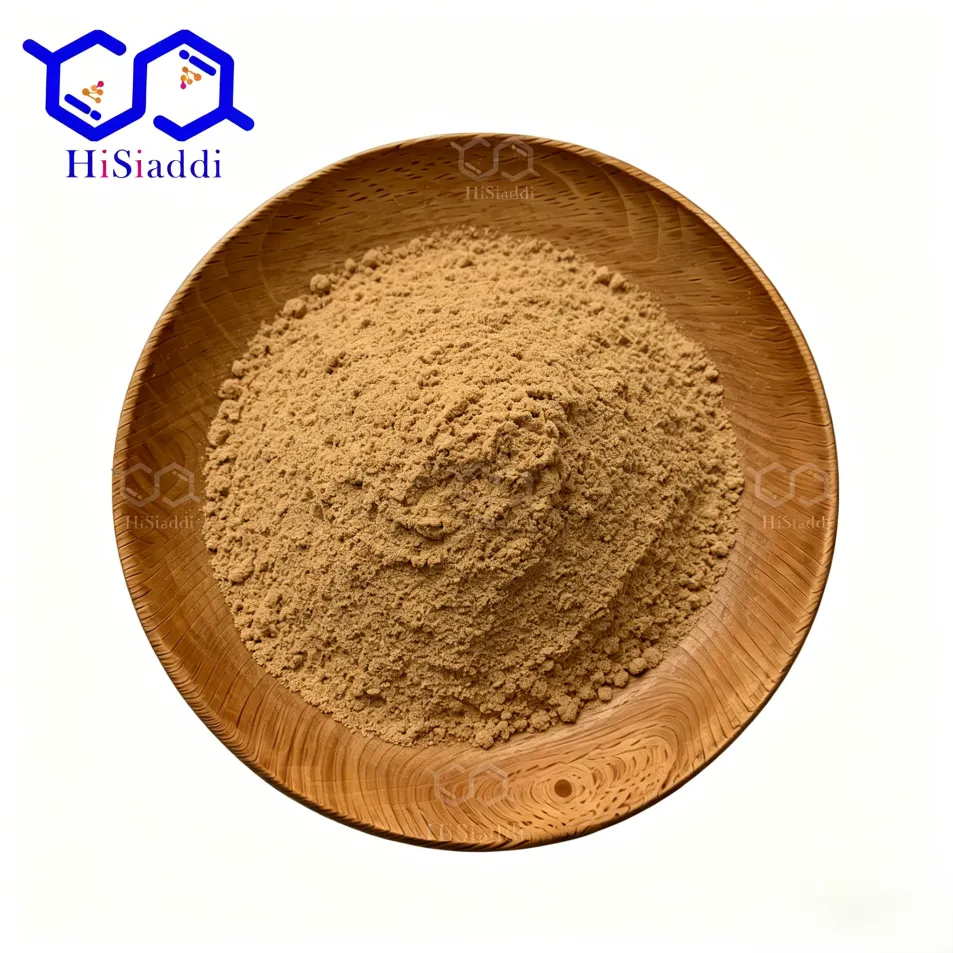
As a new-type foreign trade service provider driven by technological transformation and foreign trade services, HiSiaddi has established a "1+2+3+4=1" service system and can supply raw materials of Ashwagandha Extract and Withanolides from multiple well-known original manufacturers. As a tech-driven foreign trade service provider, HiSiaddi has repeatedly resolved customized demand issues for Ashwagandha Extract and Withanolides products through technological transformation cooperation with manufacturers and precise insight into market demands. Below is a case of HiSiaddi addressing customized requirements for Ashwagandha Extract and Withanolides products.
Contact HiSiaddi customer service if you need more customized services.
The purchaser is WellNature, a premium health group based in Toronto, Canada. For 19 years, it has focused on high-end soothing preparations and stress-relief dietary supplements for premium clinics across Canada and northern America. Its products are sold in Canadian chain organic supermarkets, private rehabilitation clinics and high-end sports physical therapy centers. All product lines comply with five access standards: USP Pharmacopoeia, Canada’s NPN natural health product admission requirements, EPA pesticide residue specifications, Non-GMO certification and Kosher certification. Its core products are compound withanolide soothing soft capsules and botanical soothing oral liquids. Previously, it sourced pharmaceutical-grade Ashwagandha Extract from a renowned Indian plant extraction manufacturer year-round.
However, consecutive raw material output declines, sharp price hikes and extended sea transportation lead times exceeding 90 days in India prompted the client to launch a localized Chinese customized procurement project.
The customized core indicators differ from generic crude Ashwagandha extracts available on the market: the customized product features a total withanolide content of 5%, including Withanolide A ≥2.5% and Withanolide D ≥1.2%, with solanesol ≤0.15%; ethanol solvent residue <400 ppm; 226 pesticide residues meeting Canada’s NPN limits; powder repose angle of 36°±3° with no anti-caking agents added; raw materials sourced from compliant organic Indian Ashwagandha with full traceability across the entire planting chain.
The client independently reached out to three conventional domestic plant extraction manufacturers with customization demands. The mass-produced mainstream products of domestic manufacturers are generic crude extracts with 2.5% and 5% total withanolides, which can only guarantee the total lactone content and fail to accurately separate and control individual monomer indicators. Conventional water extraction plus ethanol crude extraction processes cannot directionally enrich Withanolide A and D. Eight rounds of sample testing all failed, either due to insufficient Withanolide A or excessive solanesol impurities. The client’s laboratory testing costs exceeded 14,000 Canadian dollars, and the new product launch plan was delayed by 63 days. Restricted by fixed mass production lines, the three manufacturers were unwilling to invest in chromatographic equipment renovation and special process R&D, making them incapable of undertaking refined monomer grading customization.
Recommended by the North American Natural Raw Materials Association, the client fully entrusted HiSiaddi with coordinating full-chain customized implementation covering raw material traceability, process R&D, lab and pilot trials, and compliance support.
By sorting out test data of unqualified samples and the client’s formulation process documents, HiSiaddi’s technical team summarized four major industry pain points that prevent conventional domestic plant extraction enterprises from delivering high-end customized products.
Most domestic manufacturers source scattered domestically cultivated Ashwagandha and bulk Indian raw materials. The active ingredient content varies drastically by producing area and harvesting season, and mixed wild hybrid strains lead to irregular fluctuations in the proportions of Withanolide A and D. Some farmers use pesticides in a crude manner, failing to provide GAP planting ledgers and field pesticide usage records required by Canada, which cannot meet the NPN raw material traceability filing requirements.
Generic market processes adopt one-time full-reflux ethanol extraction and simple impurity removal via single large-pore resin, which can only broadly control total withanolide content without separating Withanolide A, D and solanesol impurities. Solanesol is highly lipophilic and difficult to remove via conventional purification, with a general measured content above 0.35%, far exceeding the client’s 0.15% upper limit. Directional enrichment of target monomers requires differentiated chromatographic systems, which conventional mass production lines lack.
Conventional high-temperature hot air drying creates extracts with large pores and high moisture absorption rates, alongside uneven powder particle sizes and a repose angle generally above 47%, causing frequent material bridging and sticking during the client’s fully automatic capsule filling process. Manufacturers commonly add silica dioxide to improve flowability, which conflicts with the client’s "zero exogenous excipients" clean label customization clause.
Domestic manufacturers only provide national standard factory self-inspection reports, lacking CNAS third-party separate COA reports (individual monomer testing, full pesticide residue and solvent residue reports). English SDS documents fail to comply with Canadian regulatory formats, making it impossible to assist the client with NPN raw material pre-filing, even if sample indicators meet standards, resulting in failed customs clearance and market launch.
HiSiaddi assembled a team of plant extraction process engineers, North American regulatory specialists and third-party testing coordinators, screening two mid-to-high-end plant extraction enterprises in China with imported medicinal herb qualifications and flexible customized refining workshops. The customization was implemented in five stages: targeted imported raw material procurement → segmented extraction + multi-stage chromatographic customization → low-temperature modified drying → multi-gradient sample verification → full compliance supporting, divided into three verification phases: 50g lab samples, 40kg pilot trials and 3.6 tons mass production.
HiSiaddi partnered with licensed Indian medicinal herb exporters to source standardized GAP-cultivated Ashwagandha from Maharashtra, India. Only 3-year-old medicinal rhizomes harvested in the annual winter ripening period were selected. Each batch comes with Indian Ministry of Agriculture phytosanitary certificates, plot soil test reports, field plant protection ledgers and cross-border customs documents. All documents are filed with Chinese-English notarization to stabilize raw material base ingredients from the source, enabling full traceability from Indian farmlands to finished domestic products and satisfying traceability inspections by Canadian drug authorities.
Abandoning traditional full-reflux crude extraction, low-temperature enzymatic pre-treatment plus gradient ethanol segmented percolation extraction was adopted: segmented extraction at 42°C avoids monomer decomposition caused by high temperatures. Two types of resins (non-polar and medium-polar) were used for serial chromatography: the first stage enriches total withanolides, the second stage precisely separates solanesol impurities, followed by trace alumina refining to further remove lipophilic impurities. After multiple rounds of elution parameter adjustment, the finished product stably meets all target ranges: total lactones 5.02%~5.10%, Withanolide A 2.53%~2.61%, Withanolide D 1.21%~1.27%, solanesol 0.11%~0.14%.
Hot air drying was replaced with negative-pressure low-temperature vacuum freeze-drying to minimize powder pores and moisture absorption. After freeze-drying, sealed airflow crushing and precise sieving optimize particle size distribution. The finished product maintains a stable repose angle of 35.5~37°, achieving natural loose powder via crystal form and particle size optimization without any anti-caking excipients, suitable for clean vegetarian formulations and fully automatic capsule filling. Under 53% ambient humidity, moisture absorption weight gain within 72 hours is ≤0.65%, completely resolving material agglomeration and machine blockage during feeding.
The factory’s ethanol recovery section was renovated with three-stage low-temperature negative-pressure solvent removal, stabilizing finished ethanol residue at 290~370 ppm. Each batch of imported raw materials undergoes full 226-item pesticide residue screening upon arrival at the factory; raw materials failing inspection are rejected directly. Heavy metal levels in finished products are all superior to USP limits, tested by CNAS laboratories issuing full test reports.
HiSiaddi coordinated third-party institutions to issue Chinese-English COA reports with separate monomer breakdowns and full pesticide residue data, compiled English SDS safety data sheets in accordance with Canadian regulations, and consolidated notarized raw material traceability documents and copies of Kosher certificates to assist the client with pre-filing of NPN raw materials in Canada in advance. The complete file package is used for the client’s finished drug administration filing.
After five rounds of cross-border sample delivery and full physical-chemical and formulation pilot verification by Canadian laboratories, all indicators of the customized withanolide extract passed NPN pre-review. The first batch of 3.6 tons, vacuum foil-sealed and temperature-controlled packaged, was shipped by sea to Toronto bonded warehouses. After raw material production, the capsule production line operated stably for 26 consecutive days without filling blockages, with filling error controlled within ±2%, and finished product rejection rate dropped from 25.3% with generic raw materials to 1.8%. The soothing new product, delayed for 63 days, was successfully launched across all premium pharmacies and physical therapy institutions in Canada.
The client immediately signed an annual long-term framework procurement order of 17.2 tons, scheduled for monthly production in 10 batches. Subsequent customized demand for water-soluble modified Ashwagandha Extract for premium oral liquids was fully entrusted to HiSiaddi for overall process control and compliance declaration. Compared with raw materials imported from India originally, the comprehensive procurement cost of localized customized products decreased by 30.1%, and sea transportation lead time was shortened from 88 days to 25 days.
In the following year, relying on stable customized raw materials, WellNature expanded its premium wellness market in the United States and Mexico, and launched customized low-irritation withanolide raw materials for pet soothing dietary supplements. HiSiaddi continued fine-tuning internal control indicators based on regulatory requirements of different North American regions. Endorsed by this mid-to-high-end Canadian brand, the two cooperating domestic plant extraction manufacturers upgraded customized production lines for imported raw materials, and successively secured long-term customized orders from three equivalent premium dietary brands in the U.S. and Mexico, escaping the low-price homogeneous competition of domestic generic raw materials and transforming into high-end customized raw material manufacturers. Drawing on this project, HiSiaddi established a segmented customization database for withanolides, improving an integrated service system covering imported raw material traceability, monomer graded purification and North American compliance.
The vast majority of domestic Ashwagandha Extract manufacturers focus on mass production of generic specifications based on total lactone content, with fixed production lines and processes. Their R&D investment prioritizes cost reduction, lacking special process R&D for directional monomer enrichment and refined impurity removal. They lack awareness of segmented indicators under North American NPN and USP Pharmacopoeia standards and formulation production conditions. While overseas mid-to-high-end wellness brands are proficient in local regulations and terminal formulations, they are unfamiliar with process shortcomings of domestic plant extraction and supply chain rules for imported raw materials, making independent direct procurement prone to customization failures, delayed new product launches and wasted testing costs.
Breaking away from the traditional spot resale foreign trade model, HiSiaddi positions itself as a technology-driven foreign trade service provider, connecting the full service chain from overseas raw material traceability and customized process R&D to powder physical property modification and cross-border compliance implementation. It bridges the technical gap between overseas high-end customization demands and domestic mass production processes, helping high-end domestic plant extracts enter mid-to-high-end North American dietary supply chains.
Contact HiSiaddi customer service for more customized service inquiries.
 +86-13120989737
  info@hisiaddi.com
 English