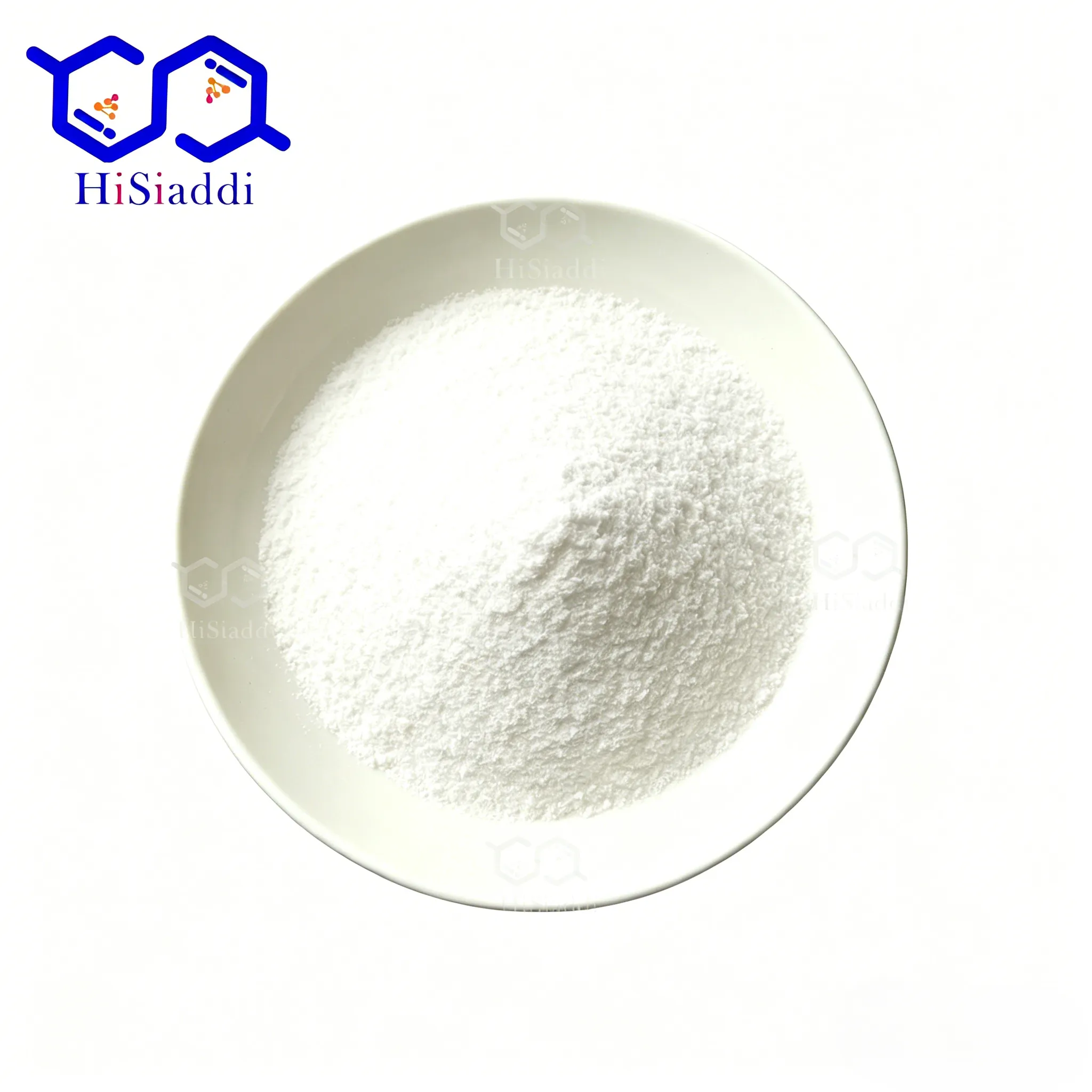
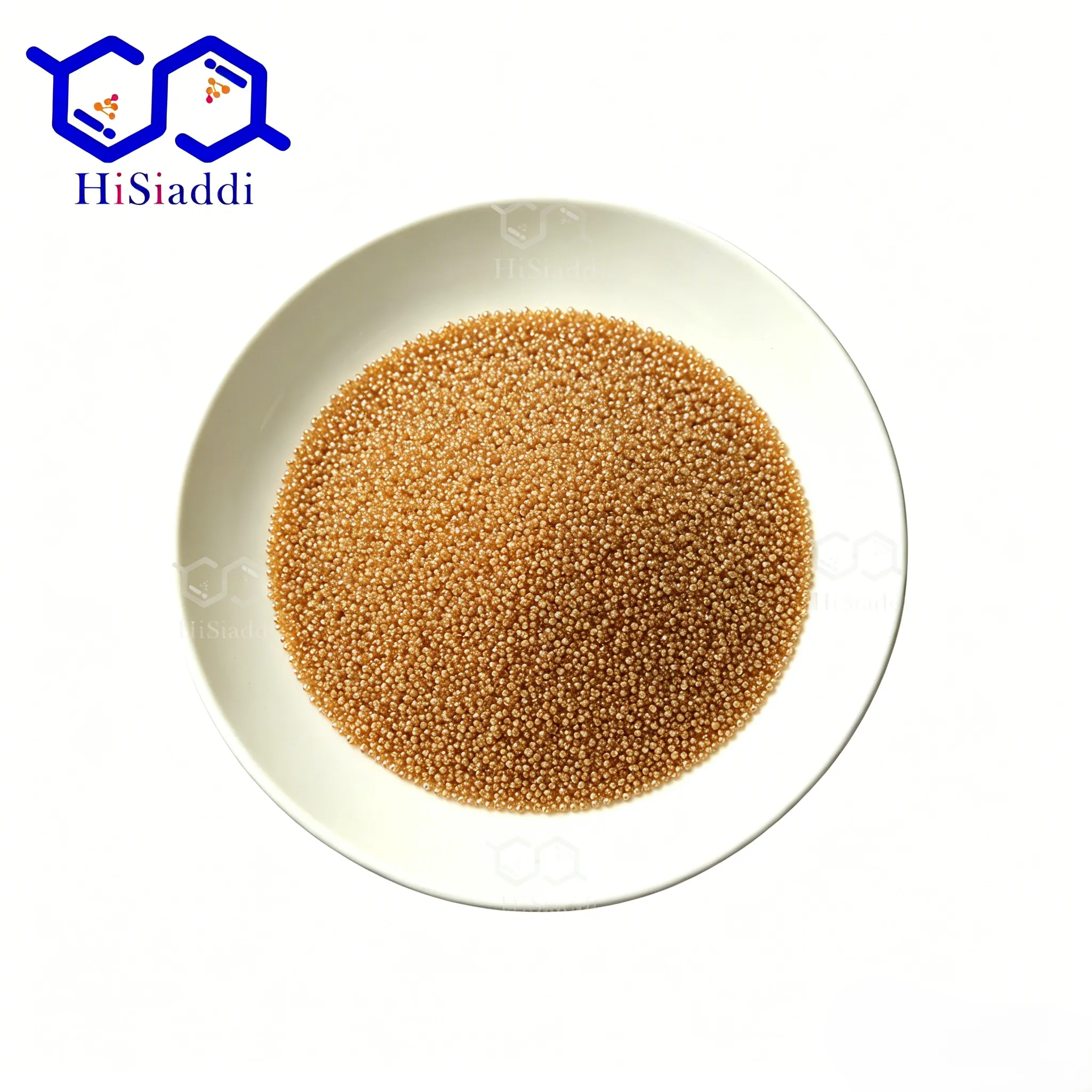
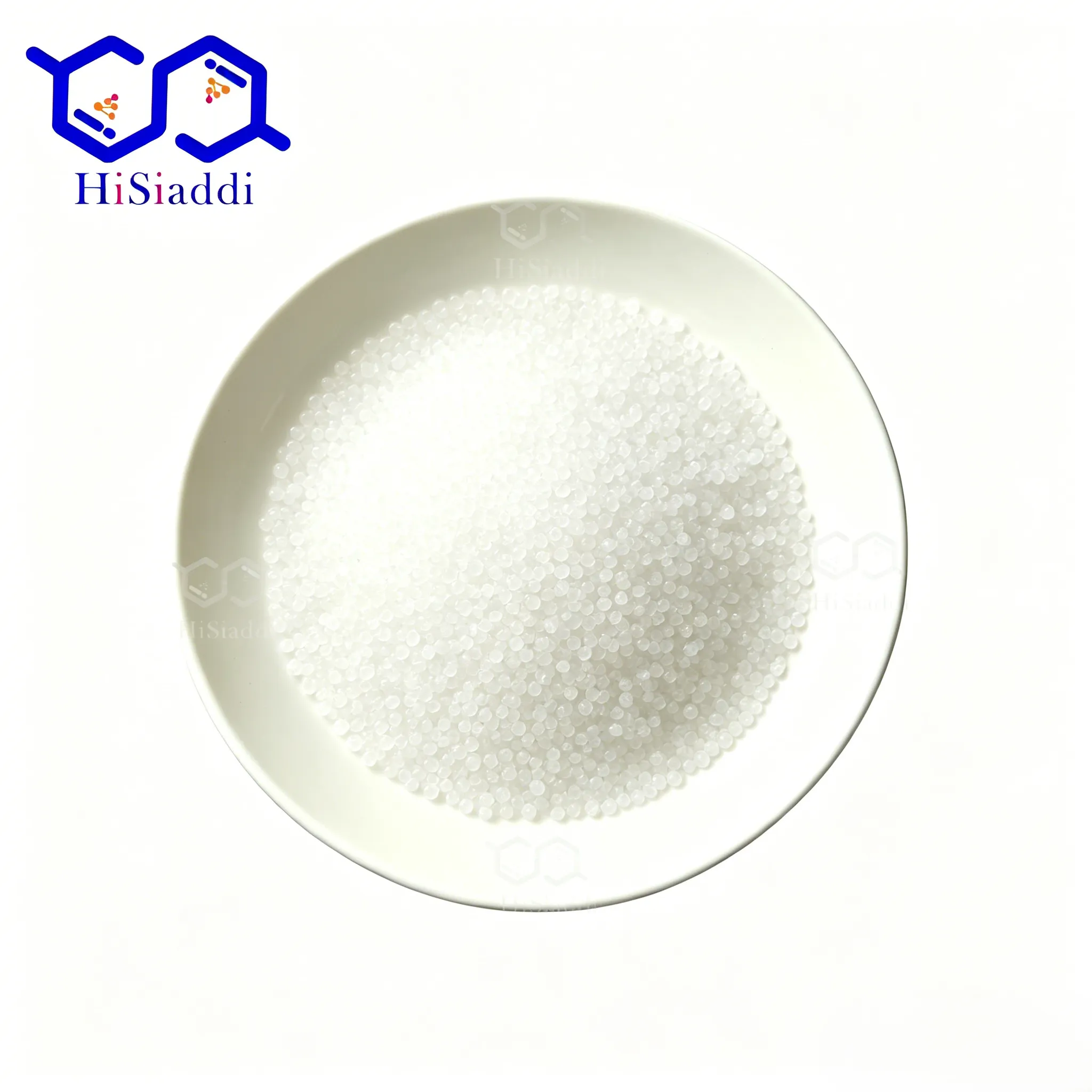
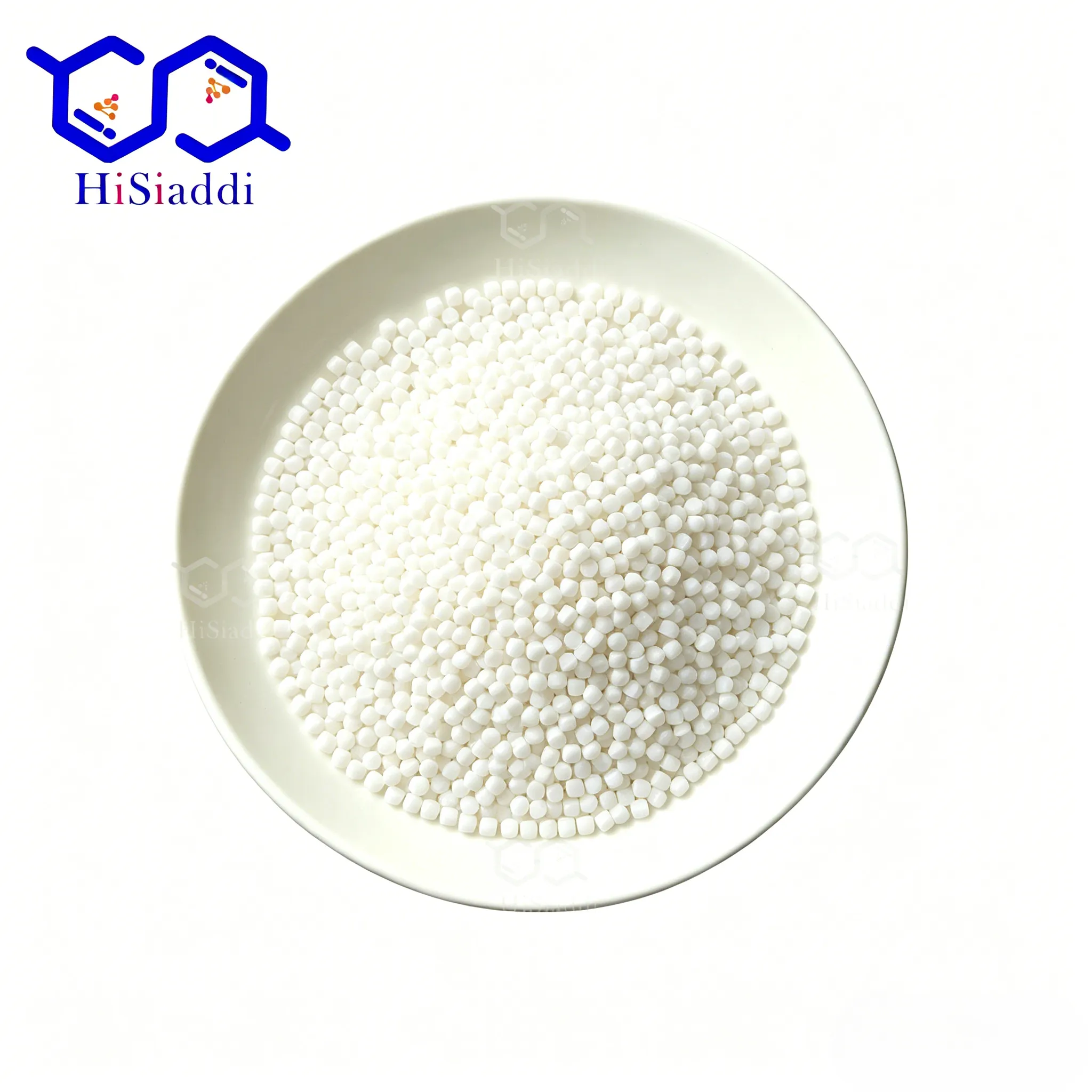
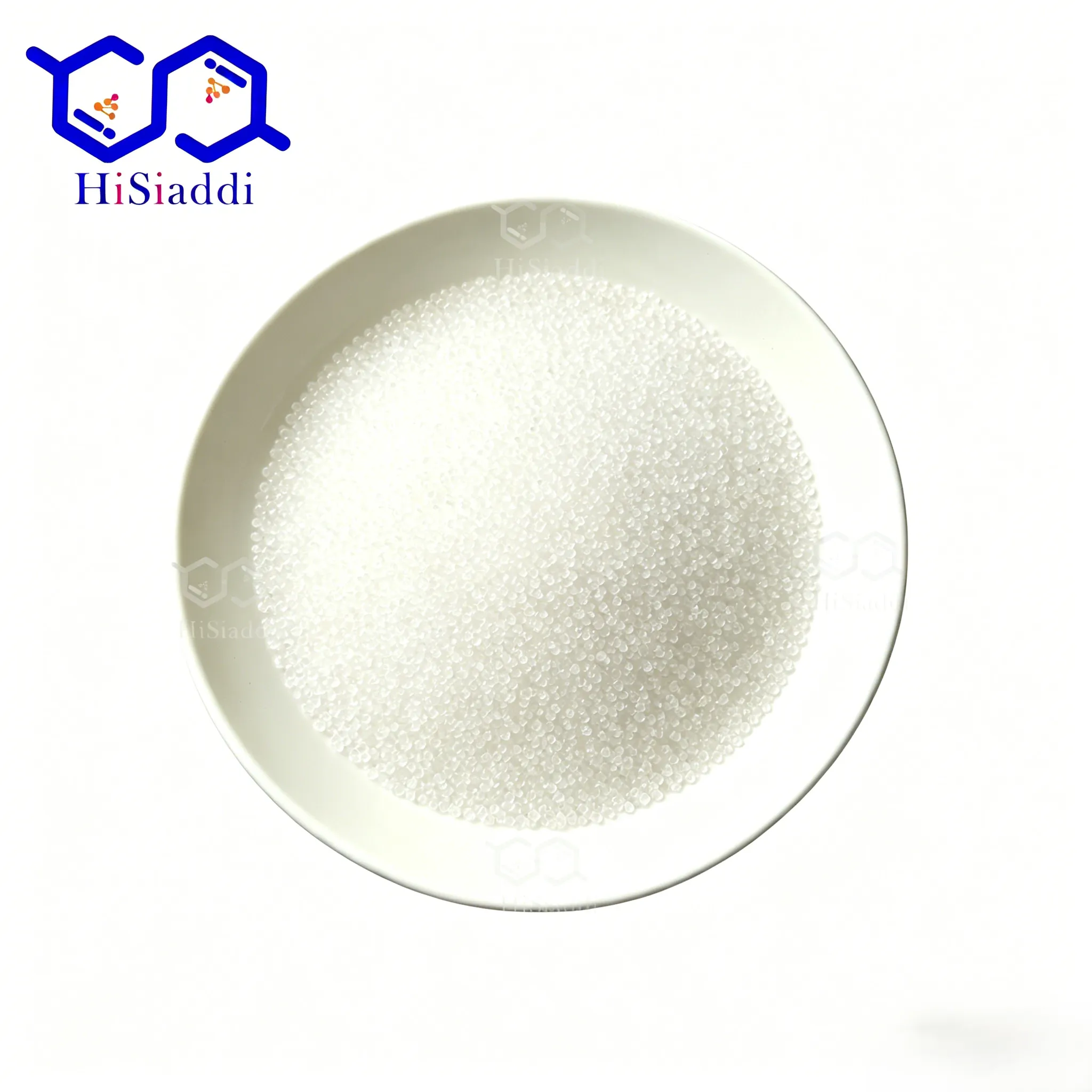
Polybutylene Succinate abbreviated as PBS, it is used in degradable mulch film, disposable packaging and catering containers. HiSiaddi can supply original factory sources of multiple Chinese brands and provide "1+2+3+4=1" services.
Lanshan Tunhe: PBS-1000, PBS-2000 (high toughness grade), melting point 115℃, heat distortion temperature ≥85℃, elongation at break ≥270%, biodegradation rate ≥90% (180 days), low temperature resistance down to -30℃, comparable with Japan Mitsubishi Chemical, 30%~40% lower in price, suitable for degradable mulch film manufacturers, disposable catering container factories and food packaging enterprises.
Biodehsuko: PBS-BD10 (extrusion grade), PBS-BD20 (film blowing grade), bright color (L value ≥84), terminal carboxyl group ≤15mol/t, suitable for high-speed film blowing and extrusion, international grade quality, 25%~35% lower in price.
HiSiaddi Service: Customization of melt flow rate (5~60g/10min) and aging resistance / high toughness modification; formula optimization of degradable mulch film, molding process of disposable packaging, technical support for replacing Mitsubishi Chemical; testing on melt flow rate, tensile strength and biodegradation rate.
 CONTACT HiSiaddi NOW
| CAS No: | 25777-14-4 | Brand Name: | Multi-brand |
| MF: | N/A | Model Number: | Multi-models |
| EINECS No: | N/A | Grade: | N/A |
| Purity: | N/A | Place of Origin: | Hebei, China |
| MOQ: | 1ton | Storage: | Please refer to the product packaging or contact the customer service. |
When you purchase Polybutylene Succinate (PBS) as a buyer, you may encounter the following questions:
What are the key index advantages and application influences of mainstream models from well-known PBS brands?
What competitive services can PBS suppliers provide?
How about qualification certifications and market feedback of targeted PBS brands?
What is the inventory level and supply stability of PBS suppliers?
What factors need to be considered when selecting PBS?
...and many other related questions.
HY PBS 801: General film-blowing grade, equivalent to Showa Denko Bionolle 1020MD
HY PBS 901: Ultra-high toughness ultra-thin film special grade
HY PBS 701: Injection molding grade for disposable products
HY PBS BLEND: Special grade for PLA blending modification
Molecular weight: 80,000-120,000, PDI<1.6 with narrow molecular weight distribution, high melt strength to avoid film breakage, ideal for overseas ultra-thin 0.015-0.025μm degradable shopping bags
Excellent toughness & tear resistance: Elongation at break ≥700%, outstanding toughness at room temperature and 20℃ low temperature, effectively solving film breakage problems in low-temperature regions such as Northern Europe and North America
Superior hydrolysis resistance with end-capping modification, controllable hydrolysis speed in humid environment, product shelf life over 12 months, far better than common PLA
Full biodegradation compliance: Certified by EN13432, ASTM D6400, OK Compost and OK Marine, fully degradable within 180 days under industrial composting conditions with zero heavy metal residues
Perfect compatibility with PLA: Direct addition ratio 15%-30% to greatly improve toughness, impact resistance and low-temperature resistance of PLA without extra compatibilizer
Stable batch performance via continuous polymerization process, slight fluctuation of melt index and viscosity, matching high-speed film-blowing and injection molding production lines overseas
Cut core raw material procurement cost by 43%-53%, greatly boosting profit margin and market competitiveness of overseas degradable film enterprises under global plastic restriction policies
Ultra-high toughness enables ultra-thin film production to reduce raw material consumption and further lower overall product cost
Direct blending with PLA simplifies formula design and eliminates compatibilizer usage, cutting formula debugging costs
Sufficient large-scale domestic production capacity ensures stable peak-season supply, avoiding price hikes, supply shortages and ultra-long delivery cycles of Japanese and German original brands
Low-temperature resistant and tear-proof degradable shopping bags and agricultural films are suitable for cold regions in Northern Europe and North America
Tough disposable tableware avoids brittle cracking for better user experience
Fully degradable in compost and seawater after disposal, eliminating soil and marine microplastic pollution
HF PBS BIO: 100% high-purity bio-based grade, equivalent to BASF ecoflex bio-based products
HF PBS AH: Long-term hydrolysis-resistant modified grade
HF PBS HP: High-purity grade with ultra-low residual monomers
Fully bio-based raw materials: Succinic acid and 1,4-butanediol sourced from biomass fermentation, bio-based content ≥95%, ultra-low carbon footprint to qualify for EU CBAM carbon tariff exemption
Ultra-low residual monomers (<0.1%), nearly odorless and non-irritating, ideal for food contact and high-end packaging applications
Advanced deep end-capping technology realizes controllable hydrolysis cycle of 12-24 months in humid and seawater environments, applicable to marine and tropical humid regions
Food-grade certification compliant with FDA, EU 10/2011 and LFGB standards, safe for direct food-contact degradable products
Full bio-based property helps clients avoid EU carbon tariffs and strengthen market competitiveness in European markets
Low-odor and high-purity properties support access to high-end overseas supermarket supply chains
Long-term hydrolysis resistance adapts to high-temperature humid markets in Southeast Asia and the Middle East to explore blue ocean markets
Safe and odorless food-grade degradable packaging meets high-end food consumption demands in Europe and America
Marine degradable products degrade gradually in seawater to alleviate ocean plastic pollution
LS PBS G80: General industrial film-blowing grade
LS PBS M60: High-flow special injection molding grade
LS PBS MOD: Modified toughening special grade
Cost advantage from large-scale continuous polymerization equipment with stable output, perfectly matching overseas bulk industrial procurement demand
Excellent fluidity for easy processing, suitable for high-speed injection molding and thin-walled disposable products to improve molding efficiency
Good weather resistance with UV and heat-humidity resistance, applicable to outdoor agricultural films and exterior packaging
Complete compliance certifications including REACH, RoHS and OK Compost for global universal market layout
Ultra-low unit price for bulk orders fits large-scale assembly line production overseas
High fluidity boosts injection molding efficiency and reduces labor and energy consumption costs
Sufficient inventory ensures zero supply shortage during peak seasons
Weather-resistant agricultural degradable mulch films adapt to global green agricultural transformation
Lower cost of daily disposable eco-friendly products promotes popularization
JF PBS F: Special grade for spinning non-woven fabrics
JF PBS FR: Halogen-free flame-retardant modified grade
JF PBS 3D: Flexible grade dedicated for 3D printing
Superior spinnability with low impurity and gel content, stably producing 0.8-3D ultra-fine fibers for spunlace non-woven fabrics and degradable sanitary products
UL94 V0 halogen-free flame retardancy, suitable for degradable electronic cushioning packaging and new energy eco-friendly accessories
High flexibility and bendability for flexible cultural and creative products and medical flexible brackets
Strong modification compatibility to adjust toughness and viscosity as required to meet niche high-end customized demands
Spinning-grade products match overseas high-speed spunlace production equipment with low yarn breakage rate and stable operation
Flame-retardant modified products help enter high-end industrial packaging markets and avoid vicious price competition in common film industry
Flexible 3D printing materials expand niche markets of cultural creation and medical supplies overseas
Rapidly degradable wet wipes and sanitary products reduce environmental pollution after disposal
Safe and flexible flexible 3D printed products are applicable to children’s cultural goods and medical rehabilitation equipment
FY PBS LT: -40℃ ultra-tough low-temperature resistant grade
FY PBS PRE: Integrated PLA/PBS pre-blended compound
FY PBS OCEAN: Exclusive deep-sea degradable grade
Excellent ultra-low temperature toughness without cracking or embrittlement at -40℃, ideal for frigid regions including Northern Europe, Russia and Canada
Optimized proportional pre-blended pellets eliminate separate blending, drying and granulation procedures for direct film-blowing and injection molding
Special formula resistant to high salinity and deep-sea high pressure, perfect for deep-sea fishing gear and underwater packaging
Flexible customized modification services to rapidly respond to special order demands for extreme cold, deep sea and tropical working conditions overseas
Ultra-low temperature resistant products capture blue ocean markets in high-latitude countries to realize differentiated competition
Pre-blended materials simplify production processes and cut equipment investment and labor costs
Deep-sea degradable products seize policy dividends of global marine environmental protection
Frost-resistant and crack-proof degradable films and agricultural films enjoy longer service life in extremely cold areas
Naturally degradable deep-sea fishing gear effectively reduces underwater plastic waste

| Comparison Dimension | Shandong Huiying New Materials | Zhejiang Huafeng Bio-based | Xinjiang Lantian Tunhe | Guangdong Kingfa | Anhui Fengyuan Biochemical |
| Export Ranking | 1 | 2 | 3 | 4 | 5 |
| Core Business Segments | General film-blowing, high-toughness ultra-thin film, exclusive PLA blending | High-purity bio-based, long-term hydrolysis-resistant, food-contact grade | General industrial film-blowing, high-flow injection molding, bulk industrial grade | Spinning non-woven, halogen-free flame retardant, flexible 3D printing | -40℃ ultra-low temperature tough, deep-sea degradable, PLA/PBS pre-blended |
| Main Export Models | HY PBS 801/901/701/BLEND | HF PBS BIO/AH/HP | LS PBS G80/M60/MOD | JF PBS F/FR/3D | FY PBS LT/OCEAN/PRE |
| Benchmark Overseas Brands | Showa Denko Bionolle, BASF general grade | BASF ecoflex, SK Chemicals bio-based series | SK Chemicals, Novamont general industrial grade | Novamont, BASF modified series | Showa Denko niche modified, BASF deep-sea special grade |
| Core Advantages | MW 80000-120000, PDI<1.6; Elongation ≥700%; 20℃ low temp toughness; good PLA compatibility; EN13432&OK Marine dual certification | Bio-based ≥95%; residual monomer<0.1%; long-term hydrolysis resistance; FDA food grade; ultra-low carbon footprint | Large-scale capacity; high fluidity for easy injection molding; UV resistance; ultra-high cost performance; suitable for mass production | Low gel for ultra-fine fiber spinning; UL94 V0 flame retardancy; high flexibility; fit spunlace non-woven & 3D printing | No embrittlement at -40℃; salt & pressure resistant for deep sea; integrated pre-blending; flexible customized modification |
| Price Ratio vs Overseas Brands | 47%-57% | 45%-55% | 44%-54% | 46%-56% | 54%-64% |
| Cost Performance Rating | ★★★★★ | ★★★★★ | ★★★★☆ | ★★★★☆ | ★★★★ |
| Core Overseas B2B Clients | Degradable bag/film factories, agricultural film plants, PLA/PBS masterbatch factories, disposable injection molding product makers | High-end food packaging factories, marine degradable product producers, EU-oriented eco-material suppliers | Bulk disposable product factories, agricultural mulch film plants, small & medium modified masterbatch suppliers | Degradable non-woven factories, sanitary product makers, flame-retardant packaging & 3D printing consumable suppliers | Frigid-region product manufacturers, deep-sea fishing gear producers, integrated pre-blended material enterprises |
| Downstream B2B Benefits | 1. 43%-53% raw material cost cut2. Ultra-thin film saves raw materials3. Simplified PLA blending formula4. Stable peak-season supply | 1. Avoid EU carbon tariffs via bio-based property2. Low odor for high-end food packaging3. Hydrolysis resistance expands tropical markets | 1. Low unit price for bulk purchase2. High fluidity improves injection efficiency3. Ample stable supply | 1. Compatible with high-speed spinning equipment2. Differentiated competition via flame retardant modification3. Expand 3D printing niche markets | 1. Occupy frigid-region blue ocean markets2. Pre-blended materials simplify production3. Benefit from marine environmental protection policies |
| End-user Benefits | 1. Low-temperature tear resistance for Northern Europe & North America2. Anti-crack disposable tableware3. Zero soil & marine pollution | 1. Safe high-end food packaging2. Natural degradation of marine products | 1. Weather-resistant agricultural films2. Affordable daily eco-products | 1. Eco-degradable sanitary supplies2. Safe & flexible 3D printed goods | 1. Durable anti-freeze products in cold areas2. Less plastic waste in deep sea |
HiSiaddi, a new foreign trade service provider driven by both technology transformation and foreign trade business, has built a "1+2+3+4=1" product service system, which consists of 1 foreign trade salesperson with over 3 years of experience, 2 R&D teams and 3 high-quality suppliers supported by 4 warehouses to fulfill one-stop product demand.
With this service system, HiSiaddi boasts deeper expertise in R&D optimization and technical processes of PBS Granule than most foreign trade companies, a clearer grasp of market demands and competitive advantages of various PBS Granule brands than single factories, and a more thorough understanding of the PBS Granule foreign trade market than research institutions.
HiSiaddi only recruits foreign trade sales staff with over 3 years of working experience, who must receive more than 6 months of training from both the R&D team and foreign trade team before serving customers.
(1)PBS Granule Basic Support Service
Backed by the foreign trade team and corporate service system, we provide customers with full-process one-stop document handling services, including but not limited to issuance and processing of all types of compliance certificates for PBS Granule, provision of third-party test reports and resolution of quality warranty issues.
(2)PBS Granule Exclusive Premium Service
PBS Blind Sample Benchmark Service. We supply anonymous domestic PBS and imported samples from Showa Denko and BASF for independent testing of toughness and low-temperature performance to intuitively verify domestic substitution performance.
PBS Application Physical Sample Package. We provide granular samples, ultra-thin blown films, PLA/PBS injection parts and biodegradable lunch boxes for clients to visualize end-product effects.
Global PBS & Biodegradable Material Monthly Intelligence Push Service. We release updates on overseas competitor pricing, plastic ban and CBAM carbon tariff policies, and demand in film and agricultural sectors to help clients avoid policy risks.
Through in-depth cooperation with source factories via technology transformation and internal collaboration with the foreign trade team, we provide technical training for sales staff to realize professional PBS customization and offer research-level consulting for PBS/PLA blending optimization.
(1)PBS Granule Research-Grade Customization Service
Import Substitution Benchmark Special Service. For clients purchasing Showa Denko, BASF and SK imported PBS, we compare molecular weight, elongation at break, low-temperature toughness and hydrolysis resistance fully, issuing dedicated substitution reports unavailable to ordinary traders.
PBS Technology Transfer & Custom Modification Service. We cooperate with domestic biodegradable research institutes to develop -40℃ super-tough cold-resistant grades, fully bio-based PBS, deep sea biodegradable variants and PLA/PBS pre-blended materials, realizing full lab-to-mass production technical conversion.
Joint R&D of Exclusive Custom PBS Grades for long-term key clients to build differentiated biodegradable packaging materials.
(2)PBS Granule Research-Grade Consulting Service
Overseas Localized PLA-PBS Blending Technical Service. Our biodegradable material team provides remote guidance on blending ratios, anti-brittle injection and anti-tear blown film formulas unavailable to regular traders.
Food-Grade & Bio-Based Safety Testing. Every batch provides third-party residual monomer and bio-content test reports to meet EU standards.
Marine & Industrial Compost Degradation Testing compliant with OK Marine and EN13432 standards.
Carbon Footprint & EU CBAM Support Service to calculate full-life carbon emissions and cut import carbon costs.
Extreme Low Temperature & Damp Heat Aging Testing to prove material stability.
Ultra-Thin Film & Spinning Process Optimization to reduce breakage rates.
Our foreign trade and R&D teams jointly conduct preliminary market surveys, on-site factory inspections, product testing, in-depth technology transformation cooperation and bulk procurement cooperation to select around 3 reliable, stable, reputable and promising brand manufacturers.
(1)PBS Granule Greater Initiative to Secure Lower Prices
Long-term cooperation through technology transformation and authorized distribution enables us to source original factory goods at preferential prices.
(2) PBS Granule Long-Term Supply Chain Guarantee Service
Long-term partnership in technology transfer and distribution strengthens production process monitoring, full batch traceability, batch stability control and compensation guarantees for batches failing third-party inspection.
We have 4 warehouses, which are jointly operated and managed with suppliers to store hot-selling products.
(1)PBS Granule Fast Delivery & On-Site Emergency Handling
The four warehouses are located at Qingdao Port (North China), Ningbo Port (East China), Shenzhen Port (South China) and Zhengzhou (inland logistics hub), ensuring timely delivery of PBS Granule. On-site staff can resolve transportation damage, packaging defects and export compliance issues locally.
(2) PBS Granule Price Stabilization & Custom Packaging Support
We stock up in advance to mitigate drastic price hikes during peak seasons. Self-operated warehouses support highly customized packaging and label solutions for clients.
As an innovative foreign trade service provider driven by both technology commercialization and cross-border trading, HiSiaddi has established a "1+2+3+4=1" service system and can supply genuine raw materials from multiple well-known original manufacturers of PBS Granule. As a tech-driven foreign trade enterprise, we will professionally sort out common difficulties faced by B-end buyers sourcing PBS Granule in China and propose targeted solutions from HiSiaddi.
If you require more professional and in-depth analysis regarding PBS Granule procurement, please contact HiSiaddi’s customer service team.
Stringent multi-national eco-compliance standards, strict control over melt index and thermal stability, volatile upstream 1,4-butanediol feedstock prices, and high susceptibility to moisture absorption and hydrolysis during logistics and storage.
1.
Differentiated Compliance Classification & Access StandardsProducts are segmented into blown film grade, injection molded tableware grade, agricultural film grade and food contact grade. The EU enforces REACH, RoHS and EN13432 biodegradability certifications, while food-grade variants must meet EU 10/2011 and US FDA 21CFR standards. Controlled indicators include MFR, moisture content, succinic acid monomer residue, ash content, melting point, heavy metals and biodegradation rate. Each batch must be accompanied by English COA, SDS, certificate of origin and third-party biodegradation test reports. Leading end manufacturers will detain or reject shipments with incomplete certifications or out-of-spec indicators.
2.
3.
Physical Property Fluctuations Cause Mass Production ScrapExcessive moisture induces hydrolysis under high processing temperatures, resulting in brittle tableware and film rupture. MFR inconsistency leads to uneven film thickness and extrusion strand breakage during blown film production. PBS features strong hydrophilicity; high temperature and humidity inside ocean containers during long-distance shipping trigger water absorption and hydrolysis, causing a sharp drop in mechanical strength and rendering materials unprocessable.
4.
5.
Petrochemical-Derived 1,4-Butanediol & Succinic Acid Are Subject to Crude Oil Price Volatility & Plant MaintenanceLimited local PBS production capacity in Europe and America creates heavy reliance on domestic polymerization plants in China. Standard sea freight plus customs clearance takes 5–7 weeks. Concentrated raw material stocking during peak seasons for agricultural film and disposable consumer goods leads to container space shortages and delayed deliveries, forcing downstream production lines to halt. Raw material prices surge by 20%–33% during supply shortages.
6.
1.
One-Stop Compliance Documentation for Customs Clearance & Factory AuditsSeparate production lines for food/blown film/injection/agricultural grades with complete supporting certifications including EN13432 compostability certificate, REACH and FDA food contact registration. English test reports align with European and American industrial standards, and we assist importers with customs filing and factory audit reviews.
2.
3.
Closed Esterification Polycondensation & Deep Dehumidification Pelletizing to Lock Narrow-Range IndicatorsNegative-pressure polymerization removes small molecular monomers, and pellets undergo constant-temperature deep dehydration with third-party SGS sampling inspection before factory release. Sealed packaging with PE vacuum inner liners and 25kg kraft paper bags blocks moisture and prevents hydrolysis during ocean shipping.
4.
5.
6–12 Month Annual Long-Term Price Lock + Bonded Warehouse Stock in Europe & AmericaLong-term framework agreements lock base prices with annual price adjustments capped at 5%. Bonded warehouses in Rotterdam and Los Angeles maintain 2–3 months of spot inventory, enabling local delivery within 3–5 working days for standard orders. Urgent test samples can be airfreighted to arrive within 48 hours.
6.
Premium surcharges for small-batch orders, widespread adulteration of fillers, high production loss due to insufficient processing expertise, and full advance payment tying up working capital.
1.Markups for Small-Volume Purchases & Price Inflation by IntermediariesSmall factories typically order 100–300kg per batch, while the industry standard minimum order quantity (MOQ) stands at 500kg with a 10%–18% surcharge for small lots. Many counterfeit PBS products blended with calcium carbonate or recycled PP flood the market, failing national biodegradation standards and EU testing requirements.
2.Incorrect Grade Selection & Inadequate Drying Lead to High Production LossManufacturers cannot distinguish dedicated grades for blown film vs. injection molding. Undried raw materials undergo hydrolysis after feeding, causing brittleness, with overall raw material loss exceeding 8%.
3.Long Ocean Transit Lead Time of 45–60 Days, Small Orders Delayed by 2–3 Weeks, Full Advance Payment Strains Cash Flow
1.MOQ Reduced to 100kg Without Surcharges, Direct Factory Pricing with Tiered DiscountsNo premium for minimum 100kg orders at ex-factory prices; preferential rates for 500kg lots, with an additional 4% discount for orders above 1 ton. Direct factory supply eliminates middlemen, cutting overall procurement costs by over 20%.
2.Free 1–2kg Full-Grade Test Samples + English Processing ManualsSupplied with drying parameters, extrusion/blown film temperature control and modification blending guidelines. Remote grade selection guidance restricts production loss to under 3%.
3.Consolidated Container Shipping for Discrete Orders + Flexible Payment Terms + Full-Batch Traceability WarrantyConsolidated containers shorten lead time to 30–35 days. Payment terms available as 30% advance deposit + 70% against copy of bill of lading. Each shipment includes a third-party quality inspection traceability code; fully defective batches qualify for free returns with all round-trip freight covered.
Extremely strict requirements for high-purity low-residual feedstock, unstable molding performance under low-temperature conditions, and frequent small-batch trial orders for new product R&D.
1.Food/Medical Raw Materials Require Rigorous Control Over Monomer Residues & Heavy MetalsExcess small molecule residues in premium packaging feedstock fail FDA and EU food contact testing; filler-adulterated inferior materials are barred from European and American supermarket supply chains.
2.Trace Moisture Content Under Low-Temperature Production Causes Film Pinholes & Tearable Finished Goods; Temperature Fluctuations During Long-Distance Logistics Accelerate Moisture Absorption & Material Degradation
3.Iterative Formulation Development Requires 5–20kg Test Batches, While Mass Production Lines Reject Small Trial Orders
1.High-Purity Monomer-Stripped Food-Dedicated Grades With Special Safety Test ReportsMulti-stage negative-pressure devolatilization after polymerization minimizes residual monomers and extractables to levels superior to EU limits, accompanied by dedicated SGS food contact safety reports.
2.Rheology-Modified Formulations for Wide-Temperature Hydrolysis-Resistant Molding StabilityOptimized molecular chain distribution reduces hydrolysis-induced film rupture under high/low temperature extrusion, improves blending stability with PLA, and extends shelf life of finished goods.
3. 5kg Minimum R&D Test Orders With Priority Scheduling on Dedicated Small-Scale Production LinesCustom modified grades with tailored MFR available to support formulation debugging and laboratory testing for overseas clients.
Difficult compatibility control for multi-type biodegradable resin blends, moisture absorption and hydrolysis risk from open feeding, and heavy supply guarantee pressure for ten-thousand-ton bulk procurement.
1. Agglomeration & Delamination During Mixing With PLA, Talc & Inorganic Fillers Result in Unqualified Mechanical Properties of Entire Batches of Compounded Masterbatch
2. High Humidity in Workshop Environments Causes Foaming and Brittle Defects After Raw Material Moisture Absorption & High-Temperature Processing
3. Annual Ten-Thousand-Ton Bulk Procurement Suffers Profit Compression From Raw Material Price Hikes; Production Line Shutdowns Trigger Heavy Losses Due to Material Shortages, Requiring Compatibility With Automated Closed Feeding Systems
1.Dedicated Blending-Modified PBS Grades With Pre-Verified Full-System CompatibilityPre-blending validation completed for mainstream PLA modification formulas to optimize compatibility and achieve uniform dispersion without agglomeration.
2.Ultra-Low Moisture Factory Specifications + Warehouse Humidity Control GuidelinesDeep dehumidification treatment before factory release, paired with standardized closed storage and temperature-moisture control protocols to reduce hydrolysis loss.
3.Tiered Volume Discounts for Large Orders + Annual Production Capacity Lock-In + Multi-Spec Packaging OptionsTiered preferential pricing for orders above 5 tons; full-container shipments cut logistics costs. 25kg bags and 500kg bulk bags are available to adapt to automated closed feeding production lines.
Capital occupation from multi-grade inventory stocking, inability to detect adulteration without testing equipment, and frequent after-sales issues caused by moisture absorption of pellets.
1. Stocking Multiple Grades for Blown Film/Injection/Agricultural Applications Ties Up Large Amounts of Working Capital
2. Lack of In-House MFR and Moisture Testing Equipment Risks Procurement of PBS Adulterated With Calcium Carbonate Powder, Triggering Claims When End Products Fail Biodegradation Tests
3. Complex Customs Clearance for Discrete Orders; Rainwater Exposure and Moisture Hydrolysis During Sea Freight Lead to High After-Sales Compensation Costs
1. Mixed-Grade Consolidated MOQ, Third-Party Repackaging & Drop Shipping From Overseas Bonded Warehouses Enabling Zero-Inventory Operation for Distributors
2. Full-Set Third-Party COA Supplied With Every Shipment + Simple Self-Inspection Protocols; Full Compensation for Round-Trip Logistics Fees for Out-of-Spec Products
3. Vacuum Moisture-Barrier Sealed Packaging + Specialized Chemical Customs Clearance Services; Full Logistics Traceability Greatly Reduces After-Sales Cases Caused by Moisture Absorption & Hydrolysis
If you require more professional and in-depth analysis regarding PBS Granule procurement, please contact HiSiaddi’s customer service team.
Weight-average molecular weight: 95000±3500 g/mol
Melt flow rate (190℃/2.16kg): 21±1.0 g/10min
Melting point: 116±2℃
Glass transition temperature: ≤ -30℃
Tensile strength: ≥ 36 MPa
Elongation at break: ≥ 420%
No cracking after 1000 low-temperature bending tests at -20℃
Complete biodegradation within 210 days in soil environment
Compliant with food contact standards with no peculiar odor
Appearance: Uniform milky white granules, particle size: 2.4±0.2 mm
Compatible with three processing technologies: film blowing, injection molding and extrusion
Product shrinkage rate: ≤ 0.5%
Stable performance for 12 months under sealed and dry storage
Difficulty in balancing high molecular weight and process fluidity: Increased molecular weight improves toughness but reduces melt fluidity, which adversely affects film blowing.
Mutual restriction between low-temperature toughness and heat resistance: Enhancing low-temperature bending resistance tends to decrease heat deflection temperature.
Precise control of the 210-day biodegradation cycle: The hydrolysis rate of molecular chains needed to be strictly regulated to meet the service requirements.
Strict control for food-grade materials with low odor and low migration: Oligomers generated during polycondensation easily cause peculiar odor and substance migration.
High requirements for cross-border packaging: PBS is highly hygroscopic, so special moisture-proof and hydrolysis-resistant packaging was required for ocean transportation.
Complex compliance work: A large number of testing items for EU biodegradable material and food contact standards led to long certification and document preparation cycles.
Strict production quality control: The allowable fluctuation range of toughness, melt flow rate and biodegradation performance among production batches was extremely narrow.
Adopted melt polycondensation combined with post-viscosification technology to precisely control molecular weight and melt flow rate; the actual tested melt flow rate reached 20.5 g/10min.
Optimized the flexible structure of molecular chains and matched with low-temperature toughening additives, ensuring no cracking during bending tests at -20℃.
Precisely regulated hydrolysis sites on molecular chains to achieve complete biodegradation in 210 days.
Applied multi-stage vacuum treatment to remove oligomers and residual monomers thoroughly, eliminating peculiar odor and meeting food contact safety standards.
Packaged granules with vacuum moisture-proof packaging and adopted dry and temperature-controlled transportation for ocean shipment.
Completed all tests in accordance with EU standards and filed compliance documents for review and record.
Insufficient low-temperature toughness, resulting in brittle fracture of films.
Excessive hydrolysis sites on molecular chains led to overly fast biodegradation and shortened service life.
Residual oligomers caused peculiar odor, failing to meet food application requirements.
Moisture absorption of raw material granules led to air bubbles during molding.
Unstable melt flow rate among batches caused uneven film thickness during film blowing.
Replaced the original material with low-temperature resistant modified PBS, and optimized the cooling process for film blowing to solve the brittleness problem.
Selected PBS grades with controllable hydrolysis rate and adjusted molecular chain structure to extend the service life and slow down excessive biodegradation.
Adopted food-grade raw materials with thorough oligomer removal, and improved ventilation in production workshops to eliminate peculiar odor.
Set pre-drying conditions: dried raw materials at 80℃ for 2.5 hours; controlled warehouse humidity below 45% and implemented sealed storage to avoid moisture absorption and air bubbles.
Established raw material incoming sampling inspection system to strictly control performance differences between batches.
Compiled standardized operation specifications for processing and warehousing, and provided professional training for on-site staff.
Lead time
Quantity (ton) | 0 - 10 | 10 - 30 | > 30 |
Lead time (days) | 7 | 15 | To be negotiated |
testtesttesttesttesttesttest
As a new-type foreign trade service provider driven by dual engines of technology commercialization and export services, HiSiaddi has built a "1+2+3+4=1" service system and can supply PBS Granule sourced directly from multiple well-known original manufacturers.
As an R&D-focused foreign trade operator, HiSiaddi avoids the biased brand promotion typical of single-factory suppliers. We provide objective analysis of China’s top export-competitive PBS brands, sharing their certification portfolios and real market feedback to streamline buyers’ sourcing decisions.
For more authentic, objective profiles of major Chinese PBS Granule brands, contact HiSiaddi customer service.
1. TH803S General Injection Molding Grade (Flagship core product, 52% of company PBS export volume) Melting point: 113.5~115°C; tensile strength: 39~41MPa; elongation at break: 380%~420%; MFR (190°C/2.16kg): 2.8~3.5g/10min. Optimized for high-temperature injection molding, primarily used for disposable cutlery, heat-resistant takeaway containers and seedling trays. Top export destinations: Germany, Netherlands, Poland, Malaysia, Vietnam. Repeat orders from overseas small-to-medium tableware processors exceed 88%.
2. TH803F Film Blowing Grade (Leading film export grade, 31% of exports) Highly crystallized modified base resin compatible with PBAT blending ratios of 0~80% without delamination; puncture resistance ≥120kN/mm. Designed for biodegradable supermarket shopping bags, cross-border courier packaging and economical farm mulch film, widely stocked as a co-blending base resin by European flexible packaging manufacturers.
3. TH803M Spinning & Weather-Resistant Agricultural Film Grade (Differentiated specialty grade, 17% of exports) Controllable degradation modified base resin with built-in UV stabilizers, adjustable degradation cycles of 180~720 days, split into two sub-applications: (1) Long-cycle crop mulch film for sugarcane and fruit trees; (2) Eco-friendly fishing monofilament and non-woven fiber for Southeast Asian fisheries and tropical plantations.
1. Top Global Degradation Certifications (Mandatory Market Access Credentials) DIN CERTCO EU OK Compost industrial compost certification (all grades certified); U.S. BPI ASTM D6400 certification for unrestricted North American compost market access; full coverage of Japan JBPA biodegradation, Australia ABAM compostable and South Korea Eco-Label eco-certifications.
2. Food Contact Compliance Credentials All grades filed under U.S. FDA 21CFR177.1520; compliant with EU 10/2011 and German LFGB food contact standards, enabling direct supply to European and American food processing chains for tableware and fresh produce trays.
3. Environmental & Management System Certifications ISO 9001 quality management, ISO 14001 environmental management, ISO 14067 full-product carbon footprint certification (carbon footprint reports available for all grades to support EU CBAM carbon tariff accounting); EU REACH chemical registration and RoHS hazardous substance compliance.
4. National-Level Official Endorsements MIIT National Champion Product in Manufacturing (biodegradable PBS category); National Green Factory; co-writer of China’s national biodegradable plastic standards; raw material recommended after on-site verification by the UN FAO for agricultural biodegradable applications.
1. EU Market (Germany, Austria, Netherlands) European supermarket chains Aldi and Lidl place annual framework orders for TH803S to produce disposable fresh food trays and takeaway tableware. Buyer feedback: Among comparable-priced competitors, melt index batch fluctuation ≤±0.2g; no deformation or harmful substance leaching when holding hot food at 100°C; annual delivery fulfillment rate of 99.5%, designated alternative raw material for supermarket green packaging programs.
2. Southeast Asian Agricultural Market (Thailand, Indonesia) Large-scale Thai rubber and Indonesian palm plantations purchase TH803M long-cycle mulch film. Farm field testing: Mechanical property retention remains 62% after 12 months of open-air tropical sun exposure, fully degrading post-harvest without soil residue; listed as an approved green agro-input by local agricultural ministries.
3. Fisheries & Non-Wovens (Vietnam, Malaysia) Coastal Vietnamese fishing net manufacturers use TH803M for aquaculture enclosures, fully degrading in seawater within 24–30 months to eliminate marine microplastic pollution from discarded fishing gear; publicly recommended raw material by regional fisheries associations.
1. KF-PBS100 High-Purity General Grade (Main export staple, 46% of export volume) Manufactured via high-purity low-impurity polymerization with ash content <0.01%; melting point 114~116°C. Primary applications: room-temperature food packaging containers, disposable takeaway boxes; top export destinations: North American and Western European food processing factories.
2. KF-PBS200 Heat-Resistant Modified Grade (Flagship industrial modified grade, 35% of exports) Factory-modified heat-resistant variant with heat distortion temperature of 121°C and low VOC emissions. Optimized for new energy vehicle interior small parts and eco-friendly 3C electronic inner packaging, supplied to European and American auto component and electronics OEMs.
3. KF-PBS300 Antibacterial High-Transparency Grade (Premium medical/fresh produce specialty grade, 19% of exports) Light transmittance of 83%~87%; built-in inorganic silver antibacterial agent with >99.9% antibacterial efficacy against standard EU and domestic test strains. Dual use cases: (1) High-barrier fresh produce trays for Nestlé and Danone; (2) Substrate for small absorbable medical dressings.
1. Premier Food Contact Certifications Triple global top-tier food contact accreditations: FDA, EU 10/2011 and German LFGB for all grades, permitting direct contact with fresh produce, cooked food and oily foodstuffs.
2. Degradation Specialized Certifications Full dual certification portfolio: OK Compost and BPI (ASTM D6400) to satisfy mandatory biodegradation regulations for European and American supermarket packaging.
3. High-End Industry Exclusive Access Certifications (Barrier-Creating Credentials)
· Medical vertical: ISO 10993 biocompatibility test reports and ISO 13485 medical device quality management system certification (KF-PBS300 qualified).
· Automotive vertical: IATF 16949 automotive component material system certification (exclusive credential for KF-PBS200).
1. End-Customer Major OEM Qualifications Approved green supplier for Walmart; listed raw material supplier for IKEA; certified compliant packaging material for Amazon.
1. North American Supermarket Supply Chains (U.S., Canada) Walmart and Costco source KF-PBS100 for supermarket fresh produce clamshell packaging. Procurement team feedback: Superior impurity control delivers finished product reject rates below 1.2%; viable long-term replacement for imported European PBS cutting overall procurement costs by 12%.
2. Global Food Giant Supply Chains (European factories of Nestlé, Unilever) KF-PBS300 high-transparency antibacterial trays hold chilled dairy products. Under identical storage conditions, fresh shelf life extends 2–3 days; antibacterial performance passed re-inspection by EU food safety laboratories under continuous 3-year annual price-lock procurement contracts.
3. European New Energy Vehicle Manufacturers (VW, Renault Tier 1 Suppliers) KF-PBS200 modified resin produces small door interior components and battery protective casings. Automaker lab evaluation: No volatile odor under high-temperature cabin conditions, superior thermal stability versus standard general-grade PBS; listed as a green component material for vehicle models.
1. WH-PBS Bio50 (50% bio-based base resin, flagship export grade, 51% of export volume) 50% of feedstocks derived from bio-based BDO and bio-based succinic acid; carbon footprint of 2.85~2.90kgCO₂e/kg; standard melting point of 114°C. Applications: general packaging, label films, single-use tableware; primary market focus: EU low-carbon compliance sectors.
2. WH-PBS110 High-Flow Injection Molding Grade (General industrial resin, 29% of exports) High MFR of 14~16g/10min for defect-free high-speed thin-wall injection molding; used for miniature electronic insulation parts and daily chemical injection caps, exported to European and Turkish daily chemical processors.
3. WH-PBS120 High-Heat Engineering Grade (Premium modified base resin, 20% of exports) Modified heat resistance up to 125°C with 35% improved impact strength; automotive interior frameworks and medium-small medical consumable blanks, supplied to European and American auto modification factories and medical intermediate manufacturers.
1. Core Low-Carbon & Bio-Based Authoritative Certifications (Exclusive Competitive Credentials for EU Market) ISO 14067 full-product carbon footprint certification, PAS2050 full lifecycle carbon accounting, EU OK Biobased bio-based content certification (Bio50 officially verified ≥50% bio-carbon content). Critical documentation for EU enterprises to meet ESG reporting requirements and mitigate CBAM carbon tariff liabilities.
2. Standard Degradation & Food Contact Credentials Full-grade OK Compost, BPI, FDA and EU 10/2011 compliance; complete REACH and RoHS registration filings.
3. Industrial Manufacturing System Certifications IATF 16949 automotive material certification, ISO 50001 energy management system, full ISO 9001/14001 quality and environmental management system portfolio.
1. European Chemical Conglomerate Supply Chains (BASF, Covestro European Modification Plants) Bio50 is designated as a fixed bio-based co-blending base resin. Client R&D department feedback: Stable bio-based composition with traceable carbon footprint data directly usable for finished product carbon accounting, reducing EU carbon tariffs by 35–75 EUR per ton for end goods – the core competitive advantage valued most by European purchasers.
2. European Beverage Brands (Danone, Red Bull European Bottling Facilities) Bio50 fabricates bottle labels and beverage outer trays; finished products pass EU green product spot checks, enabling brands to highlight bio-based eco-materials in ESG communications with an 8%–15% retail product premium.
3. European NEV Supply Chains (BMW, VW Tier 1 Suppliers) Modified WH-PBS120 produces non-structural interior plastic components; long-term high-low temperature cycling lab testing shows no cracking, low VOC emissions meeting EU in-cabin environmental standards; annual order growth of 27% over the past three years.
1. TC-PBS101 General Film Blowing Grade (Flagship cross-border courier bag resin, 55% of export volume) Balanced toughness formulation optimized for 3:7 PBS/PBAT co-blending; low crystal count and superior puncture resistance. Primary supply for biodegradable courier bags manufactured by Amazon, Shein packaging suppliers; key export regions: Southeast Asia, European and American flexible packaging factories.
2. TC-PBS202 High-Barrier Modified Grade (Premium fresh produce film specialty grade, 25% of exports) Factory-blended barrier additives deliver 42% improved oxygen barrier performance versus standard PBS; vacuum fresh produce packaging and pharmaceutical inner packaging films exported to German and Italian flexible packaging manufacturers.
3. TC-PBS303 Controllable Degradation Mulch Film Grade (Bestselling tropical mulch film, 20% of exports) Built-in tunable degradation additives offering customizable 180–720 day degradation cycles with UV anti-aging performance; mulch film for cash crops in Vietnam, Indonesia and Brazil.
1. Degradation & Food Contact Market Access Full-grade OK Compost, BPI, ASTM D6400 and Japan JBPA certifications; FDA and EU 10/2011 food contact compliance.
2. Management Systems & Low-Carbon Credentials ISO 9001, ISO 14067 carbon footprint certification, China National Green Product certification; enterprise co-writer of national standards GB/T19277 and GB/T32366 for biodegradable plastics.
3. Cross-Border Platform Qualifications Amazon green packaging raw material supplier listing certification, Temu supplier compliance audit credentials.
1. European & American Cross-Border Packaging Sector (U.S., German Packaging OEMs) Shein and Temu partner packaging factories place long-term bulk orders for TC-PBS101 courier bag resin. Buyer feedback: Same certification-grade raw material priced 18%–22% lower than European domestic alternatives; flexible minimum order quantities for custom modified formulations with stable 7–10 day delivery lead times.
2. European Premium Fresh Produce Flexible Packaging (German & Italian Food Packaging Plants) TC-PBS202 high-barrier film produces vacuum chilled meat packaging. Third-party testing confirms barrier performance approaching certain PET films with full industrial compostability, resolving compliance issues with non-degradable traditional PET packaging; retail fresh food brands accept a 12% packaging premium.
3. Southeast Asian Tropical Agriculture (Vietnamese Coffee Plantations, Brazilian Fruit & Vegetable Farms) TC-PBS303 custom long-cycle mulch film withstands tropical high heat and rainfall without premature powdering, fully degrading post-harvest; listed as a recommended green agro-input by Vietnam’s Ministry of Agriculture.
1. HL-PBS G1 General Injection Molding Grade (Flagship export resin, 60% of export volume) Standard national specification performance with unrivaled cost advantages; single-use tableware and daily plastic injection parts, primary export destinations: Saudi Arabia, UAE, Nigeria.
2. HL-PBS F2 Film Blowing Grade (Flexible packaging raw material, 25% of exports) Stable film blowing performance with broad processing tolerance compatible with small-to-medium film blowing equipment; general shopping bags and economical agricultural mulch film exported to Africa and Eastern Europe.
3. HL-PBS I3 High-Rigidity Injection Molding Grade (Industrial small parts resin, 15% of exports) Superior rigidity to standard PBS with low-temperature crack resistance; eco-friendly children’s toys and miniature home appliance plastic fittings purchased by small-to-medium Eastern European injection molding factories.
1. International Market Access Credentials Full-grade OK Compost, BPI and ASTM D6400 biodegradation certifications; FDA and EU 10/2011 food contact compliance; complete EU REACH and RoHS registration filings.
2. Management System Certifications ISO 9001 quality management and ISO 14001 environmental management system certifications; basic IATF 16949 automotive material qualification.
3. Regional Major OEM Supplier Qualifications Qualified supplier certification for Saudi SABIC Group; green plastic raw material listed supplier for Nigeria’s Dangote Group.
1. Middle Eastern Supermarket Market (Saudi Arabia, UAE Local Retail Chains) Mass volumes of G1 grade produce disposable tableware and supermarket shopping bags. Local buyer evaluation: Fully compliant with Gulf Cooperation Council plastic ban regulations at procurement costs far below imported Japanese and Korean PBS; consistent year-round inventory with zero supply disruption risks.
2. African Agricultural Market (Nigerian, Kenyan Smallholder & Large-Scale Farms) Economical F2 mulch film withstands arid open-air African growing conditions with sand and UV resistance; finished product damage rates reduced by 30% versus low-quality local modified biodegradable alternatives, the top-selling raw material for African importers.
3. Eastern European Small-Scale Injection Molding (Poland, Romania Processing Plants) I3 grade fabricates eco-toys and daily consumer goods. Factory feedback: Broad processing window enabling stable production on standard domestic or second-hand European injection molding equipment, with reject rates capped below 3% – ideal cost-performance ratio for Eastern European low-cost consumer goods markets.
1. EU Domestic Markets (CBAM Low-Carbon Mandates + Full Biodegradation Certifications Required): Prioritize Wanhua Chemical Bio50 (low-carbon tariff mitigation), Lanshan Tunhe full grades (most complete certification portfolio)
2. North American Supermarket & Food Packaging: Kingfa Science & Technology, Lanshan Tunhe (dual FDA + BPI certification, established supermarket OEM supplier qualifications)
3. Cross-Border E-Commerce (European/American/Southeast Asian Courier Bags): Tongcheng New Materials – superior cost-performance plus flexible custom modification capacity
4. Middle Eastern, African Low-Cost General-Grade Markets: Hengli Petrochemical full product line – maximum cost advantage for emerging market demand
5. Global Agricultural Mulch Film (Tropical & Long-Cycle Crops): Lanshan Tunhe TH803M, Tongcheng TC-PBS303
6. Automotive & Medical Premium Modified Applications: Kingfa Science & Technology, Wanhua Chemical specialized modified grades
For more authentic, objective profiles of major Chinese PBS Granule brands, contact HiSiaddi customer service
As a new-type foreign trade service provider driven by dual engines of technology commercialization and export services, HiSiaddi has built a "1+2+3+4=1" service system and can supply PBS Granule sourced directly from multiple well-known original manufacturers.
As an R&D-focused foreign trade operator, HiSiaddi avoids the biased brand promotion typical of single-factory suppliers. We provide objective analysis of China’s top export-competitive PBS brands, detailing their manufacturing workflows, supply chain reliability and core performance indicators, alongside the downstream procurement impacts of these factors to streamline buyers’ sourcing decisions.
For more authentic, objective profiles of major Chinese PBS Granule brands, contact HiSiaddi customer service.
Lanshan Tunhe operates dual petroleum-based and bio-based raw material routes built around a continuous esterification-vacuum polycondensation integrated process – China’s earliest stable ten-thousand-ton scale production line.
· Raw Material Stage: Self-sourced partial BDO plus external supply; bio-based succinic acid prioritized (30% bio-based feedstock share) with purity ≥99.5% to control impurities at the source.
· Polymerization Workflow:
1. Esterification: Succinic acid and BDO mixed at a 1:1.2 molar ratio, reacted at 180–200°C under atmospheric pressure with proprietary titanium-rare earth composite low-heavy-metal catalysts (REACH compliant), achieving conversion rates ≥98%.
2. Polycondensation: Excess BDO removed at 220–240°C under high vacuum (≤100Pa); polymerization runs 3–4 hours to control molecular weight between 80,000–120,000 with cross-batch fluctuation ≤5%.
· Modification Stage: TH803S (injection grade), TH803F (film grade) and TH803M (agricultural film grade) undergo inline modification via terminal functional group adjustment and inorganic filler blending (talc, UV stabilizers), eliminating secondary processing and boosting production efficiency by 20%.
· Process Advantages: Mature workflow generating only water as a byproduct with 12% lower energy consumption versus batch processes; flexible production lines switch between three core grades within ≤2 hours.
· Capacity Scale: Total PBS capacity of 130,000 tons/year (29% national market share), primary Xinjiang Changji base (124,000 tons) plus East China secondary modification base (6,000 tons); single maximum production line output of 40,000 tons/year, 2025 actual output of 112,000 tons at 86% capacity utilization.
· Raw Material Security: 3-year fixed-price long-term contracts with top BDO and bio-based succinic acid suppliers; complete local chemical industry supporting infrastructure within a 500km logistics radius mitigating raw material price volatility.
· Inventory & Delivery: Permanent safety stock of 15,000 tons (covering two months of export orders) under weekly production scheduling plus monthly price-lock contracts. EU and Southeast Asian order lead times of 7–10 days; priority allocation for long-term clients during peak seasons (mulch film season April–June, tableware season September–December) with zero historical supply disruptions.
· Risk Resistance: During the 2025 BDO price surge, long-term locked raw material costs limited factory price hikes to only 5%, far below the industry average of 15%, ranking first nationwide for supply stability.
All grades certified OK Compost/BPI/FDA; values represent factory standard specifications:
· TH803S General Injection Molding Grade: Melting point 113.5–115°C; tensile strength 39–41MPa; elongation at break 380%–420%; MFR (190°C/2.16kg) 2.8–3.5g/10min; ash ≤0.05%; terminal carboxyl group ≤12mol/t (low hydrolysis, superior aging resistance).
· TH803F Film Blowing Grade: Melting point 112–114°C; tensile strength 35–38MPa; elongation at break ≥450%; puncture resistance ≥120kN/mm; MFR 4–6g/10min; compatible with PBAT blending ratios 0–80% without delamination.
· TH803M Agricultural Film & Spinning Grade: Melting point 114–116°C; tensile strength 40–42MPa; elongation at break ≥400%; UV resistance Class 5 (60%+ mechanical retention after 12 months open-air exposure); adjustable degradation cycles 180–720 days.
· Quality Control Highlights: Cross-batch melt index fluctuation ≤±0.2g; color b-value ≤12 (high whiteness for easy pigmentation); third-party test reports supplied per batch, fully compliant with EU REACH and U.S. FDA food contact regulations.
· For injection molding downstream (tableware, cutlery): TH803S fast crystallization enables molding at 40–60°C mold temperatures, cutting cycle times by 5 seconds to lift production capacity by 8%–12% and hold reject rates ≤1.5%, lowering energy and rework expenses.
· For film blowing downstream (courier bags, mulch film): TH803F low crystal count and high puncture resistance boost film blowing speed by 15% with film thickness uniformity ±0.01mm to reduce breakage losses; TH803M tunable degradation cycles match tropical crop growing cycles in Southeast Asia and South America to avoid premature degradation or post-harvest residual plastic.
· Compliance Cost Reduction: Low ash and heavy-metal content eliminates redundant third-party testing for downstream manufacturers entering European and American markets, cutting certification overhead by 30%; consistent cross-batch performance removes the need for frequent downstream formulation adjustments and stabilizes production workflows.
Kingfa operates dual 100% bio-based and petroleum-based production workflows built around self-developed continuous esterification-polycondensation plus in-house bio-based monomer manufacturing – China’s sole producer with full self-sufficiency in bio-based succinic acid and BDO.
· Raw Material Stage: 50,000 tons/year fermented bio-based succinic acid (100% bio-carbon content, USDA/DIN certified) plus 10,000 tons/year self-produced bio-based BDO at the Qingyuan Guangdong base; purity ≥99.8% with impurity content ≤0.02% eliminating external raw material fluctuation risks.
· Polymerization Workflow:
1. Esterification: Succinic acid (70%+ bio-based share) mixed with BDO at a 1:1.15 molar ratio, reacted at 175–195°C with heavy-metal-free zirconium catalysts (residual <5ppm meeting medical-grade standards) for conversion rates ≥99%.
2. Polycondensation: Polymerization at 215–235°C under high vacuum (≤80Pa) yields molecular weights of 90,000–130,000 with polydispersity index ≤1.2 (narrow molecular weight distribution delivering stable processing fluidity).
· Modification Stage: KF-PBS100 (food grade), KF-PBS200 (heat-resistant grade) and KF-PBS300 (antibacterial grade) undergo inline functionalization via nano-inorganic filling and molecular grafting to achieve high transparency, antibacterial and heat-resistant properties without secondary re-pelletization.
· Process Advantages: Up to 100% bio-based feedstock capability with low carbon footprints of 2.6–2.8kgCO₂e/kg and 15% lower energy consumption versus industry averages, optimized for premium food, medical and automotive applications.
· Capacity Scale: Total PBS capacity of 87,000 tons/year (20.3% national market share), Zhuhai base (60,000 tons bio-based focused) plus Changzhou modification base (27,000 tons specialized modified materials); single production line capacity of 30,000 tons/year, 2025 actual output of 78,000 tons at 90% capacity utilization.
· Raw Material Security: 100% self-sufficient bio-based succinic acid and BDO; 5-year fixed-price contracts with Sinopec for petroleum-based feedstocks delivering ≥80% raw material self-sufficiency to insulate against external supply disruptions.
· Inventory & Delivery: Permanent premium grade stock of 10,000 tons (covering one month of European and American high-end orders) under customized production scheduling with priority fulfillment. Annual framework clients including Walmart and Nestlé receive 10–15 day lead times; small-batch custom orders ship within 7 days via expedited production.
· Risk Resistance: During the 2025 bio-based raw material shortage, captive in-house production maintained supply continuity with premium grade price hikes limited to 8% versus the industry average of 12%, cementing its position as the preferred supplier for European and American premium brands.
All grades certified FDA/EU food contact/ISO13485; values represent internal premium control standards:
· KF-PBS100 High-Purity Food Grade: Melting point 114–116°C; tensile strength 42–44MPa; elongation at break 350%–400%; MFR 3–5g/10min; ash ≤0.01%; VOC <10ppm (low odor, safe for direct food contact).
· KF-PBS200 Heat-Resistant Modified Grade: Melting point 118–120°C; heat distortion temperature (HDT) 121°C; tensile strength 45–47MPa; elongation at break 300%–350%; ultra-low VOC optimized for high-temperature automotive cabin environments.
· KF-PBS300 Antibacterial High-Transparency Grade: Melting point 115–117°C; light transmittance 83%–87%; 99.9% antibacterial efficacy against E. coli and Staphylococcus aureus; tensile strength 40–43MPa; elongation at break ≥380%; biocompatible for medical applications.
· Quality Control Highlights: Impurity content ≤0.02%; terminal carboxyl group ≤10mol/t (superior hydrolysis resistance for long-term service stability); FDA/ISO13485 test reports issued per batch lowering market entry barriers for premium verticals.
· For food packaging downstream (fresh produce trays, tableware): KF-PBS100 ultra-low impurity and odor enables direct contact with high-temperature oily food without inner liners cutting packaging costs by 10%; KF-PBS300 antibacterial high-transparency formulations extend chilled fresh shelf life by 2–3 days supporting 12%–15% retail product premiums.
· For automotive interior downstream (NEV component suppliers): KF-PBS200 heat resistance up to 121°C and low VOC emissions eliminate in-cabin odor under high-temperature conditions complying with European automotive interior environmental standards; component manufacturers avoid secondary modification lifting processing efficiency by 20%.
· For medical consumable downstream (dressings, trays): KF-PBS300 biocompatibility and built-in antibacterial properties remove secondary sterilization requirements for downstream producers slashing medical certification overhead and cutting market entry timelines by 50%.
Leveraging its MDI industrial chain advantages, Wanhua Chemical adopts a bio-based BDO plus petroleum-based succinic acid workflow built around proprietary continuous esterification paired with twin-screw reactive extrusion polycondensation – China’s pioneering energy-efficient manufacturing route.
· Raw Material Stage: 60,000 tons/year self-produced succinic anhydride at the Yantai base (succinic acid purity ≥99.6%); bio-based BDO external supply (50% feedstock share); raw material consumption of 0.86 tons succinic acid per ton of PBS, below the industry average of 0.92 tons.
· Polymerization Workflow:
1. Esterification: Succinic anhydride blended with BDO at a 1:1.1 molar ratio, reacted at 185–205°C with high-efficiency low-residual titanium catalysts for conversion rates ≥98.5%.
2. Polycondensation: Fast polymerization inside twin-screw extruders at 225–240°C under high vacuum yielding molecular weights of 85,000–115,000 with 40% shorter reaction cycles and 15% lower energy consumption versus traditional workflows.
· Modification Stage: WH-PBS Bio50 (50% bio-based), WH-PBS110 (high-flow) and WH-PBS120 (high-heat) are formulated via chain segment regulation and heat-resistant filler blending for inline tuning of fluidity and thermal resistance optimized for industrial injection and extrusion processes.
· Process Advantages: Low carbon footprints of 2.85–2.90kgCO₂e/kg with ≥50% bio-based content delivering significant CBAM carbon tariff savings of 35–75 EUR/ton; exceptional industrial-grade cross-batch stability.
· Capacity Scale: Total PBS capacity of 39,000 tons/year (9.1% national market share), single integrated Yantai industrial park facility of 39,000 tons; single production line capacity of 20,000 tons/year, 2025 actual output of 35,000 tons at 90% capacity utilization.
· Raw Material Security: 100% self-produced succinic anhydride; 2-year fixed-price long-term contracts with European bio-based BDO suppliers delivering 22% lower feedstock costs versus fully outsourced alternatives.
· Inventory & Delivery: Permanent low-carbon grade stock of 8,000 tons (covering one month of EU orders) under low-carbon order priority plus fixed-price long-term contract scheduling with EU CBAM market lead times of 8–12 days; EU order volume expanded by 40% in 2025.
· Risk Resistance: Cross-industry MDI chain synergies lower energy overhead; factory price hikes limited to only 6% during 2025 energy cost inflation with low-carbon product advantages offsetting margin pressure.
All grades certified OK Compost/BPI/ISO14067; values represent internal low-carbon control standards:
· WH-PBS Bio50 (50% Bio-Based): Melting point 113–115°C; tensile strength 38–41MPa; elongation at break 350%–400%; MFR 5–7g/10min; carbon footprint 2.85–2.90kgCO₂e/kg; verified ≥50% bio-based carbon content.
· WH-PBS110 High-Flow Injection Molding Grade: Melting point 112–114°C; tensile strength 36–39MPa; elongation at break ≥380%; MFR 14–16g/10min (ultra-high fluidity for defect-free thin-wall molding).
· WH-PBS120 High-Heat Engineering Grade: Melting point 119–121°C; heat distortion temperature 125°C; tensile strength 43–45MPa; elongation at break 320%–360%; 35% improved impact strength.
· Quality Control Highlights: Fully traceable carbon footprint data with cross-batch carbon footprint fluctuation ≤±0.1kg compliant with EU ESG reporting standards; ISO14067 carbon footprint test reports issued per production batch.
· For EU packaging downstream (labels, bottle preforms): WH-PBS Bio50’s ≥50% bio-based content and low carbon footprint enable finished goods to carry "bio-based eco-material" branding delivering retail ESG premiums of 8%–15% while cutting comprehensive raw material costs by 5%–10% via 35–75 EUR/ton CBAM tariff avoidance.
· For thin-wall injection molding downstream (electronic fittings, bottle caps): WH-PBS110 ultra-high MFR of 14–16g enables seamless high-speed molding of thin-wall components (≤0.5mm thickness) without filling defects; molding cycles shortened by 3 seconds lifting production capacity by 10% with reject rates capped below 2%.
· For automotive engineered component downstream (interior frameworks, protective casings): WH-PBS120 heat resistance up to 125°C and enhanced impact strength eliminate secondary modification requirements to partially substitute conventional engineering plastics cutting costs by 20% while meeting EU green automotive component standards.
Tongcheng New Materials operates PBS production under official BASF technology licensing built around continuous esterification-polycondensation plus inline high-barrier modification workflows focused exclusively on flexible packaging and agricultural film with rapid custom formulation development capabilities.
· Raw Material Stage: High-purity ≥99.5% outsourced BDO; bio-based succinic acid sourced from domestic suppliers (40% bio-based feedstock share); rigorous raw material screening limiting impurity content ≤0.03% to meet high-cleanliness flexible packaging requirements.
· Polymerization Workflow:
1. Esterification: Succinic acid blended with BDO at a 1:1.2 molar ratio, reacted at 180–200°C with titanium composite catalysts for conversion rates ≥97%.
2. Polycondensation: Polymerization at 220–235°C under high vacuum (≤120Pa) yielding molecular weights of 75,000–105,000 with polydispersity index ≤1.3 optimized for co-blending processing.
· Modification Stage: TC-PBS101 (film blowing grade), TC-PBS202 (high-barrier grade) and TC-PBS303 (agricultural film grade) undergo inline nano-montmorillonite blending and degradation agent tuning to boost barrier and UV resistance with fully customizable degradation cycles of 180–720 days.
· Process Advantages: BASF licensed technology guarantees universal compatibility with PBAT/PLA blending at any ratio without delamination; custom modified formulations delivered within 7 days at competitive price points.
· Capacity Scale: Total PBS capacity of 43,000 tons/year (10.1% national market share), single Shanghai Chemical Industry Park facility of 43,000 tons; single production line capacity of 15,000 tons/year, 2025 actual output of 38,000 tons at 88% capacity utilization.
· Raw Material Security: 1–2 year flexible fixed-price contracts with domestic BDO and bio-based succinic acid suppliers allowing volume adjustments to support small-batch custom orders.
· Inventory & Delivery: Permanent stock of 5,000 tons general-grade plus 3,000 tons custom modified material under flexible small-batch scheduling with 7-day expedited lead times. Cross-border E-commerce orders (Europe/America/Southeast Asia) ship within 7–10 days; custom Southeast Asian agricultural film orders deliver in 10–15 days.
· Risk Resistance: Deep vertical focus on flexible packaging and agricultural film maintains stable capacity utilization; order volume expanded by 30% amid the 2025 industry-wide price war supported by competitive cost positioning.
All grades certified OK Compost/BPI/FDA; values represent flexible packaging and agricultural film custom specifications:
· TC-PBS101 General Film Blowing Grade: Melting point 112–114°C; tensile strength 34–37MPa; elongation at break ≥420%; puncture resistance ≥110kN/mm; MFR 6–8g/10min; optimal compatibility with 3:7 PBS/PBAT blending ratios.
· TC-PBS202 High-Barrier Grade: Melting point 113–115°C; tensile strength 36–39MPa; elongation at break ≥400%; 42% improved oxygen barrier performance versus standard PBS; light transmittance ≥80%.
· TC-PBS303 Controllable Degradation Agricultural Film Grade: Melting point 114–116°C; tensile strength 37–40MPa; elongation at break ≥380%; UV resistance Class 4 (≥55% mechanical retention after 9 months open-air exposure); fully tunable degradation cycles 180–720 days.
· Quality Control Highlights: Low crystal count (≤3 crystals per square meter) and superior anti-aging performance; cross-batch degradation cycle fluctuation ≤±30 days optimized for tropical Southeast Asian climates; cross-border platform compliance test reports issued per batch.
· For cross-border courier bag downstream (Amazon/Shein): TC-PBS101 costs 18%–22% less than European domestic alternatives with stable co-blended film blowing performance and minimal crystal defects cutting film breakage rates by 25%; short delivery lead times accommodate small-batch high-frequency cross-border order patterns.
· For premium fresh produce flexible packaging downstream (vacuum packaging): TC-PBS202 delivers near-PET barrier performance with full industrial compostability, cutting substitution costs versus PET by 20% while supporting 12% retail premiums for fresh food brands.
· For Southeast Asian agricultural film downstream (coffee/fruit plantations): TC-PBS303 tunable degradation cycles withstand tropical high heat and rainfall without premature powdering; full post-harvest degradation eliminates plastic collection labor expenses for growers.
Hengli Petrochemical leverages its complete crude oil-aromatics-BDO vertical integration to operate a fully self-sourced petroleum-based BDO and succinic acid workflow built around standard continuous esterification-vacuum polycondensation focused exclusively on cost-optimized general-grade PBS.
· Raw Material Stage: 100% self-produced BDO and succinic acid at the Dalian Changxing Island base with purity ≥99.5%; full vertical integration delivers 25% lower raw material costs versus external sourcing with exceptional feedstock consumption control.
· Polymerization Workflow:
1. Esterification: Succinic acid blended with BDO at a 1:1.25 molar ratio, reacted at 185–205°C under atmospheric pressure with tetrabutyl titanate catalysts for conversion rates ≥98%.
2. Polycondensation: Polymerization at 225–245°C under high vacuum (≤150Pa) yielding molecular weights of 70,000–100,000 with broad process tolerance compatible with small-to-medium downstream processing equipment.
· Modification Stage: HL-PBS G1 (general grade), HL-PBS F2 (film grade) and HL-PBS I3 (high-rigidity injection grade) undergo basic inorganic filler blending (talc, calcium carbonate) for inline rigidity and fluidity tuning without complex high-cost modification workflows delivering minimal finished resin pricing.
· Process Advantages: Unmatched full vertical integration cost leadership; simplified stable manufacturing workflows compatible with low-specification processing equipment widely deployed across Middle Eastern and African emerging markets.
· Capacity Scale: Total PBS production capacity stands at 35,000 tons per year, accounting for 8.1% of China’s national total. The single production base is located on Changxing Island, Dalian, with an annual output of 35,000 tons per line and a single-line capacity of 18,000 tons. Actual output in 2025 reached 32,000 tons, representing a capacity utilization rate of 91%.
· Raw Material Security: 100% self-supply of BDO and succinic acid. Backed by a complete petrochemical industrial chain, raw material costs are locked and insulated from external price volatility. During the sharp BDO price surge in 2025, the factory only raised its ex-factory price by 3%.
· Inventory & Delivery: A permanent general-grade stock of 10,000 tons is maintained, covering three months of order demand from the Middle East and Africa. Adopting a "large-batch price lock + stable delivery" model, the lead time for orders to the Middle East and Africa ranges from 10 to 15 days. Sufficient inventory is reserved for peak seasons with zero risk of supply disruption.
· Risk Resistance: Boasting full industrial chain cost advantages, its general-grade products carry the lowest prices in the industry. Amid the industry-wide price war in 2025, order volume grew by 25%, securing the top market share in the Middle East and Africa.
Core indicators (all grades have passed OK Compost, BPI and FDA certifications; figures represent general-grade standard values):
· HL-PBS G1 General Injection Molding Grade: Melting point 111–113°C; tensile strength 32–35 MPa; elongation at break 300%–350%; MFR (190°C/2.16kg) 4–7 g/10min; ash content ≤0.1%; the lowest-priced grade.
· HL-PBS F2 Film Blowing Grade: Melting point 110–112°C; tensile strength 30–33 MPa; elongation at break ≥380%; puncture resistance ≥100 kN/mm; compatible with small and medium-sized film blowing equipment.
· HL-PBS I3 High-Rigidity Injection Molding Grade: Melting point 112–114°C; tensile strength 38–41 MPa; elongation at break 250%–300%; flexural modulus ≥450 MPa (high rigidity, resistant to cracking under low temperatures).
· Quality Control Highlights: The production process features high fault tolerance with minor batch-to-batch deviations. The material remains crack-resistant at -20°C, adapting to environments with drastic day-night temperature swings in the Middle East and Africa. A basic certification test report is provided for every batch.
· For downstream supermarket manufacturers in the Middle East (disposable tableware, shopping bags): HL-PBS G1 offers the lowest industry price and complies with plastic ban regulations of Gulf Cooperation Council countries. Its procurement cost is 30% lower than PBS imported from Japan and South Korea, with stable supply and compatibility with small and medium injection molding machines widely used in the Middle East.
· For downstream agricultural film producers in Africa (economy mulch film): HL-PBS F2 resists wind sand and sun exposure at low cost, reducing the breakage rate of finished products by 30%. It fits dry open-field planting conditions in Africa without requiring high-end processing equipment.
· For downstream injection molding factories in Eastern Europe and Africa (toys, daily small plastic goods): HL-PBS I3 delivers high rigidity and low-temperature stability, enabling steady production with ordinary second-hand injection molding equipment while keeping reject rates below 3%. Its cost-performance ratio perfectly fits the market for affordable daily consumer goods.
表格
Brand | Core Production Process | Supply Stability | Core Indicator Advantages | Key Impacts on Downstream Sectors | Best Matching Markets |
Lanshan Tunhe | Continuous esterification-polycondensation + rare earth catalyst | 99.5% order fulfillment rate, dual-base inventory buffer | Low ash content, excellent anti-aging property, superior UV resistance for agricultural film | Reduced processing loss; ideal mulch film for tropical regions | EU, Southeast Asia (agricultural film, single-use tableware) |
Kingfa Science & Technology | Full bio-based industrial chain + zirconium green catalyst | Sufficient premium-grade inventory, fast customized production | High purity, low VOC, antibacterial and heat-resistant | Premium pricing for high-end finished goods; meets medical & automotive compliance standards | Europe, North America (food packaging, medical supplies, auto parts) |
Wanhua Chemical | Twin-screw reactive extrusion + bio-based BDO feedstock | Priority delivery for low-carbon orders, long-term price-lock contracts | Low carbon footprint, high melt flow, high heat resistance | Avoid CBAM carbon tariffs; enhanced corporate ESG competitiveness | EU CBAM compliance market, automotive engineering components |
Tongcheng New Materials | BASF licensed process + high-barrier modification | Fast small-batch delivery, flexible production scheduling | High toughness, superior barrier performance, adjustable degradation cycles | Lower cross-border packaging costs; replaces PET for fresh food packaging | Cross-border e-commerce, Southeast Asian agricultural film |
Hengli Petrochemical | Fully self-produced full-chain feedstock + continuous esterification | Stable large-batch delivery, abundant inventory | Ultra-low cost, high rigidity, low-temperature crack resistance | Minimum procurement expenditure; compatible with low-end processing machinery | Middle East, Africa, Eastern Europe (general plastic products) |
For more authentic and objective detailed introductions to well-known Chinese PBS Granule brands, please contact HiSiaddi customer service.
As an innovative foreign trade service provider driven by both technology commercialization and cross-border trading, HiSiaddi has established a "1+2+3+4=1" service system and can supply genuine raw materials from multiple well-known original manufacturers of PBS Granule. As a tech-driven foreign trade enterprise, we will conduct a professional analysis of critical points and key indicators for purchasing to ease buyers’ sourcing concerns.
If you require more professional and in-depth analysis regarding PBS Granule procurement, please contact HiSiaddi’s customer service team.
PBS is synthesized via polycondensation of succinic acid and 1,4-butanediol (BDO), relying on petrochemical BDO and bio-based succinic acid supporting facilities. The total global production capacity stands at approximately 820,000 tons, with China serving as the core global production hub. Leading domestic manufacturers including Lanshan Tunhe, Kingfa Sci. & Tech, and Huasheng High-Tech have realized large-scale mass production, with complete local supporting capacity for BDO and succinic acid. Major overseas producers are concentrated in Japan, Europe and America. Affected by natural gas costs, chemical plant maintenance, and EU Carbon Border Adjustment Mechanism (CBAM), imported original materials feature a delivery lead time of 45–70 days with higher quotations, and supply shortages occur frequently during peak seasons.
Domestic integrated raw material production delivers a 23%–35% lower cost than imported equivalents. Short cross-border sea freight cycles to Southeast Asia, Japan, South Korea, the Middle East and Latin America make full-container bulk procurement highly cost-effective, rendering domestic PBS the primary global sourcing option for biodegradable feedstock.
Products are categorized into general blown film grade, injection molded food container grade, spunbond nonwoven grade, modified filled grade, and food contact dedicated grade. Basic certifications include MSDS, REACH, SVHC and RoHS. Certifications mandatory for European and American exports cover EN13432, OK Compost industrial compostability certification, ASTM D6400 and BPI. For food packaging, supplementary certifications FDA 21CFR and EU 10/2011 are required.
Most small and medium-sized overseas manufacturers lack complete compostability certifications, which may lead to cargo detention at EU ports upon inspection. Major domestic manufacturers provide COA and third-party biodegradation test reports alongside shipments for smooth customs clearance.
Grades are classified by melt flow rate (MFR) and intrinsic viscosity (IV), benchmarking mainstream grades from Showa Denko and Mitsubishi Chemical. Customizable options include low-migration food-grade resin, high-toughness low-temperature resistant modified pellets, and talc/starch-filled modified particles. Overseas original manufacturers feature fixed grades with a modification customization lead time exceeding 35 days. Domestic suppliers can flexibly adjust polymerization degree, residual monomer content and crystallization rate, as well as tailor particle color per requirements. Standard packaging options include 25kg paper-plastic composite bags and IBC bulk bags, with quick repackaging of 5kg test samples for formulation trial runs.
Viscosity and melt flow rate directly affect film toughness, low-temperature folding resistance and heat-sealing performance of finished products. Our biodegradable material engineers provide remote technical support to resolve processing defects such as film tearing during blown film production, sink marks in injection molding, and low-temperature brittleness. Classified as general eco-friendly plastic (non-hazardous chemical), PBS can be traded on FOB/EXW/CIF terms. Long-term framework orders support price locking, batch production scheduling and negotiable payment terms.
1. Melt Flow Rate (MFR, 190℃/2.16kg): 1–25g/10min. High MFR suits thin-wall injection molding; low MFR is ideal for blown film and extrusion spinning.
2. Intrinsic Viscosity (IV): 0.8–1.6dL/g. Higher viscosity corresponds to larger molecular weight and superior low-temperature toughness.
3. Melting Point: 112–118℃. The narrow processing temperature window causes sticking to molds and finished product adhesion if indicators deviate.
1. Appearance: Premium grade consists of uniform milky white cylindrical pellets free of burnt particles, yellow discoloration, agglomerates and powder. Raw materials mixed with inferior feedstock show yellowing and black specks, resulting in high defective rates during processing.
2. Density: 1.24–1.26g/cm³, applied for automated feeding ratio calculation.
1. Moisture Content: ≤0.05% for all grades. Excess moisture triggers chain scission via hydrolysis under high processing temperatures, causing film rupture.
2. Residual Succinic Acid & BDO Monomers: ≤0.25% for food-grade; ≤0.5% for general industrial grade. Excess monomers lead to strong odor in finished goods and accelerated degradation during storage.
1. Full Biodegradability: Complete degradation within 6–12 months under industrial composting conditions, complying with plastic restriction regulations worldwide, and delivering stable storage performance under normal dry conditions.
2. Low-Temperature Toughness: Resists cracking at -30℃, serving as the preferred toughening substrate for PLA blending modification.
3. Processing Compatibility: Excellent heat-sealing performance, compatible with high-speed blown film machines and injection molding equipment; miscible with PLA, PBAT and starch at any blending ratio.
Classified as general plastic pellets, PBS should be stored in cool, dry and light-shielded environments with moisture and high-temperature protection to avoid premature hydrolysis under hot and humid conditions. Packaging complies with global sea freight standards without hazardous packaging formalities.
If you require more professional and in-depth analysis regarding PBS Granule procurement, please contact HiSiaddi’s customer service team.



 +86-13120989737
  info@hisiaddi.com
 English